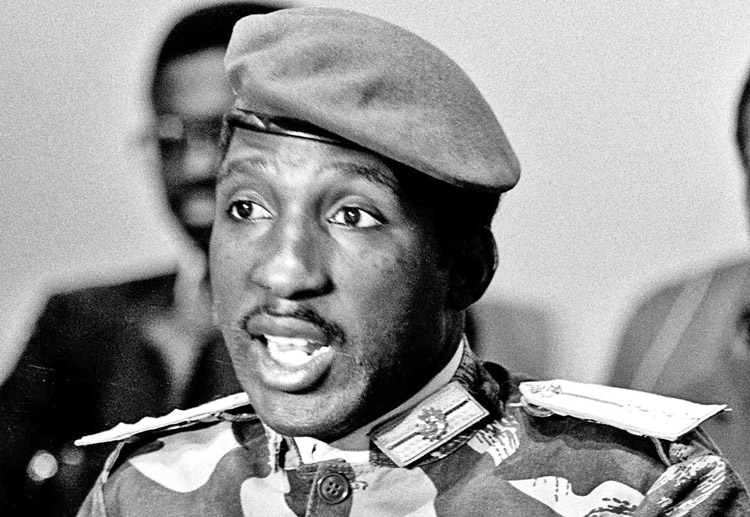
Thomas Sankara Speaks: The Burkina Faso Revolution 1983-87 is one of Pathfinder’s Books of the Month for March. In one of the poorest countries in the world, Sankara led an uprising in Upper Volta, a former French colony, in 1983, bringing to power a popular revolutionary government that organized workers, peasants, women and youth to take their destiny into their own hands. Assassinated in a counterrevolutionary coup in 1987, Sankara was an outstanding communist who stood on the shoulders of Karl Marx, V.I. Lenin, Fidel Castro and Che Guevara. His speech, “Freedom must be conquered,” at the United Nations General Assembly on Oct. 4, 1984, is excerpted below. Copyright © 2007 by Pathfinder Press. Reprinted by permission.
I come here, finally, mandated by the National Council of the Revolution of Burkina Faso, to express the views of my people concerning the problems on the agenda — consisting of the tragic web of events that are painfully cracking the foundations of our world at the end of the twentieth century. A world in which humanity has been transformed into a circus, torn apart by struggles between the great and the semi-great, attacked by armed bands, and subjected to violence and pillage. A world in which nations, eluding international law, command groups of outlaws who, guns in hand, live by plunder and organize sordid trafficking.
Mr. President:
I make no claim to lay out any doctrines here. I am neither a messiah nor a prophet. I possess no truths. My only aspiration is twofold: first, to be able to speak on behalf of my people, the people of Burkina Faso, in simple words, words that are clear and factual. And second, in my own way to also speak on behalf of the “great disinherited people of the world,” those who belong to the world so ironically christened the Third World. And to state, though I may not succeed in making them understood, the reasons for our revolt. …
No one will be surprised to see us associate the former Upper Volta, today Burkina Faso, with that hodgepodge held in such contempt — the Third World — invented by the other worlds as many countries became formally independent in order to better ensure our intellectual, cultural, economic, and political alienation.
We want to place ourselves within this world. … [W]e want to assert our awareness of belonging to a tricontinental whole and, with the force of deeply felt convictions, acknowledge, as a Nonaligned country, that there is a special relationship of solidarity uniting the three continents of Asia, Latin America, and Africa in a single struggle against the same political traffickers, the same economic exploiters.
Therefore, recognizing that we are part of the Third World means, to paraphrase José Martí, “asserting that our cheek feels the blow struck against any man in the world.” Up to now we have turned the other cheek. The blows increased. But the wicked-hearted were not moved. They trampled the truth of the righteous. The word of Christ was betrayed. … They Westernized it, whereas we had understood it as one of universal liberation. Then our eyes opened to the class struggle. There will be no more blows. …
This is what we glimpsed — we, the Burkinabè people — during the evening of August 4, 1983, when the first stars began to sparkle in the skies of our homeland. We had to take the leadership of the peasant revolts, signs of which were visible in a countryside that is panic-stricken by the advancing desert, exhausted by hunger and thirst, and abandoned. We had to give meaning to the brewing revolt of the idle urban masses, frustrated and weary of seeing limousines driving the elites around, elites that were out of touch, succeeding one another at the helm of state while offering the urban masses nothing but false solutions elaborated and conceived by the minds of others. We had to give an ideological soul to the just struggles of our popular masses as they mobilized against the monster of imperialism. The passing revolt, the simple brushfire, had to be replaced forever with the revolution, the permanent struggle against all forms of domination.
Others have explained before me, and others will explain after me, the extent to which the chasm has widened between the affluent peoples and those who aspire only to eat their fill, quench their thirst, survive, and preserve their dignity. But no one can imagine to what extent “the poor man’s grain” in our countries “has fattened the rich man’s cow”! …
We chose to risk new paths to achieve greater well-being. We chose to apply new techniques. We chose to look for forms of organization better suited to our civilization, flatly and definitively rejecting all forms of outside diktats, in order to lay the foundations for achieving a level of dignity equal to our ambitions. Refusing to accept a state of survival, easing the pressures, liberating our countryside from medieval stagnation or even regression, democratizing our society, opening minds to a world of collective responsibility in order to dare to invent the future. Shattering the administrative apparatus, then rebuilding it with a new kind of government employee, immersing our army in the people through productive labor and reminding it constantly that without patriotic political education, a soldier is only a potential criminal. Such is our political program. …
Our revolution in Burkina Faso embraces the misfortunes of all peoples. It also draws inspiration from all of man’s experiences since his first breath. We wish to be the heirs of all the world’s revolutions and all the liberation struggles of the peoples of the Third World. Our eyes are on the profound upheavals that have transformed the world. We draw the lessons of the American Revolution, the lessons of its victory over colonial domination and the consequences of that victory. …
The French Revolution of 1789, which overturned the foundations of absolutism, taught us the connection between the rights of man and the rights of peoples to liberty. The great revolution of October 1917 [in Russia] transformed the world, brought victory to the proletariat, shook the foundations of capitalism, and made possible the Paris Commune’s dreams of justice.