One of the high points of the struggle for Black freedom in the U.S. — the voting rights march from Selma to Montgomery in Alabama — took place 61 years ago in March 1965. It was a pivotal event in the Black-led proletarian movement for civil rights that would transform U.S. history, uprooting Jim Crow segregation and qualitatively strengthening the working class.
The action was led by the Student Nonviolent Coordinating Committee and Martin Luther King’s Southern Christian Leadership Conference. When demonstrators first set out March 7 from Selma, they were viciously attacked by sheriff’s deputies and state troopers and beaten back off the Edmund Pettus Bridge.
The brutality they confronted on what became known as Bloody Sunday was seen by millions on TV worldwide. Protests in solidarity with the struggle in Selma swept the U.S. Hundreds of volunteers responded to calls by march organizers to come to Selma to join the fight.
Facing another racist mobilization, some 2,000 demonstrators attempted to march again two days later. They turned back rather than face a second assault.
President Lyndon Baines Johnson, a long-standing supporter of racial segregation, refused to step in to defend the right to protest. But the outcry across the country forced him to reverse course. He addressed a joint session of Congress March 15 announcing he was going to introduce a bill “guaranteeing the right to vote” for all.
Johnson ordered the Alabama National Guard to protect a third attempt to cross the bridge March 21. It reached Montgomery March 25 and had grown from a few thousand to 25,000-strong.
The Voting Rights Act was signed Aug. 6.
U.S. politics changed forever
The march and what it helped to accomplish was just one part of the civil rights movement that had erupted nine years earlier with the Montgomery bus boycott. For more than a year, some 40,000 Black bus riders boycotted the city’s buses until they were desegregated. Solidarity from unions and working people around the country ensured vehicles were available for carpooling so workers could get to work.
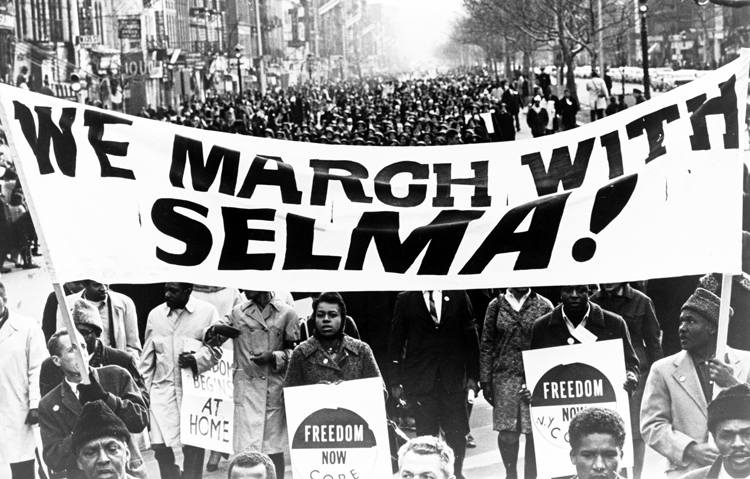
In the years that followed, freedom rides to desegregate interstate transport, sit-ins at lunch counters at Woolworths and much more were organized, along with growing efforts to register Blacks to vote. Each faced violent assaults by white supremacists, who were backed up by cops, courts and governments at all levels.
SNCC was formed out of desegregation battles in Tennessee and North Carolina. In 1963 the nationwide organization sent members to scout out Selma for a voter registration drive. But “the white folks are too mean and the Black folks are too afraid,” the SNCC scouting team reported, and the city was pushed off its list of targets.
Nonetheless, Bernard LaFayette convinced SNCC leader James Foreman to let him and his wife take on the task. He was under no illusions about what he would be up against. The Dallas County White Citizens’ Council, the founding chapter of the white-supremacist movement, had advertised in June in the local Times Journal for volunteers “to prevent sit-ins, mob marches and wholesale Negro voter registration efforts in Selma.”
LaFayette and his wife Colia “went to Selma to make a frontal attack on one of the most vicious and oppressive places in the Deep South,” Foreman wrote in The Making of Black Revolutionaries.
LaFayette wrote that when he got to Selma “there was just a small handful of Black registered voters in Dallas County” and “I’m proud to say that more than nine thousand were registered when I left.”
To get a picture of the fight LaFayette and SNCC waged in Selma, Foreman reprints the reports LaFayette sent to him on their work for the month of June 1963.
LaFayette describes being assaulted by thugs, arrested on frame-up “vagrancy” charges and other attacks. Workers attending meetings organized by SNCC and the Dallas County Voters League would be fired from their jobs the next day. Businesses supporting the voter registration drive were subject to boycotts.
But the civil rights fighters were making progress in building a serious campaign. Within weeks they were holding mass meetings in churches in the Black community to discuss what was next. The first one was held June 17, drawing over 700 people. The next day LaFayette wrote to Foreman, “You could see the new hope and smiles.”
The next meeting drew over 500, “more enthusiastic” yet, LaFayette wrote. By February 1965, 3,400 Black residents had been arrested in Selma for marching to the County Building demanding to sign up to vote.
Malcolm X joins in
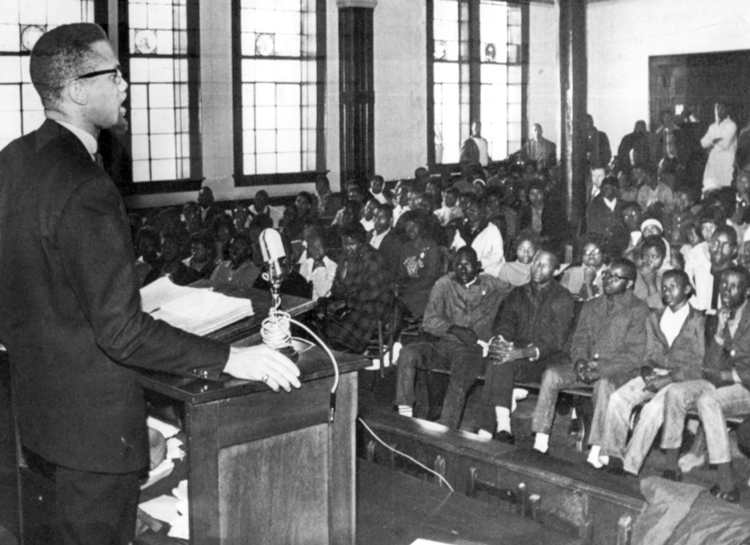
“Those people down there aren’t afraid,” Malcolm X told a meeting in New York Feb. 15, 1965, after returning from speaking in Tuskegee and in Selma.
He had gone to Selma to ask to speak at one of the mass meetings there Feb. 4, saying he wanted to show his support for the fight they were waging. LaFayette and other SNCC leaders were for it, while Southern Christian Leadership Conference members there weren’t sure. Coretta Scott King said why not, LaFayette says in his book, In Peace and Freedom: My Journey in Selma.
The speakers that afternoon were Rev. Fred Shuttlesworth from Birmingham, Malcolm X and Coretta Scott King. Malcolm “spoke powerfully,” LaFayette wrote. He said Malcolm pointed to the press as he started to speak, “You had better listen to Dr. Martin Luther King Jr. or you’ll have to listen to me. Dr. King wants the same thing I want — Freedom.”
LaFayette said word about Malcolm’s speech had spread throughout the Black community in Selma the next day, electrifying people. It helped steel people for the struggles to come. Malcolm X was assassinated Feb. 21 and didn’t live to see the Selma to Montgomery march.
One of the youngest participants on the historic Selma-Montgomery march was 15-year-old Lynda Blackmon Lowery from Selma. She worked with LaFayette and already had been jailed nine times at previous protests.
“If you are determined you can overcome your fears. And then, you can change the world,” Lowery told interviewers at the Library of Congress in 2015.
Bernard LaFayette died March 5 at age 85. A generation of fighters is passing away. Lowery died Dec. 24 at her home in Selma.