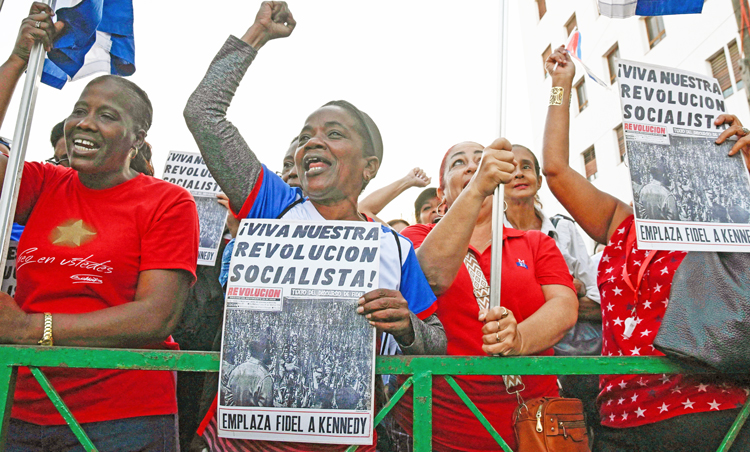
Thousands of Cubans gathered in Havana’s Vedado neighborhood April 16 to mark the 65th anniversary of both their victory over the U.S.-backed mercenary invasion at the Bay of Pigs — known in Cuba as Playa Girón — and the deepening of their socialist revolution.
Cuban President Miguel Díaz-Canel and other speakers recalled the massive popular response to the bombings carried out by the U.S.-backed mercenary forces on the eve of the invasion. Thousands of armed workers had gathered on this same corner in Vedado in 1961 to honor those killed in the bombing. Addressing the crowd, Fidel Castro outlined the stakes in defending the unfolding revolution. (His speech, featured in the Militant’s “Books of the Month” column last week, is available at themilitant.com.)
In less than 72 hours, workers and peasants across Cuba mobilized in popular militia detachments, alongside Cuba’s revolutionary armed forces and police, and dealt a stunning defeat to the invading forces, marking U.S. imperialism’s first military defeat in the Americas. Their courageous actions inspired working people and youth around the world, not the least in the United States.
Castro’s recognition of the socialist character of the revolution “changed history, and not only for Cuba,” Díaz-Canel said April 16. It marked “the definitive course of a revolutionary process started with the 1959 triumph, and that by 1961 had been deeply radicalized in favor of the dispossessed.”
Following the overthrow of the U.S.-backed dictatorship of Fulgencio Batista on Jan. 1, 1959, led by Castro, millions of working people mobilized to transform Cuba and themselves. They carried out a radical land reform, a mass campaign to wipe out illiteracy, outlawing racial discrimination, drawing women into the workforce on a large scale, and nationalizing the banks, basic industry and housing.
Leading up to the Bay of Pigs invasion, the U.S. media, taking its cue from the John F. Kennedy administration, projected the Cuban people as eagerly awaiting the arrival of the “freedom fighters.” The counterrevolutionaries “believed their own lies, but truth awaited them with guns at the ready,” said Díaz-Canel. They “expected fear,” but instead “found courage” among Cuban workers and farmers determined to defend their economic and political gains.
An account of these unfolding events in Cuba and the impact they had in winning workers and youth in the U.S. to support the Cuban people defending their own destiny can be found in Cuba and the Coming American Revolution by Socialist Workers Party National Secretary Jack Barnes.
“History would be worth very little if we didn’t learn from its lessons,” Cuba’s president said at the event. He pointed to the U.S.-organized bombings, the disinformation spread to confuse the Cuban population, along with the deepening economic war, diplomatic pressure, and constant threats against the revolution leading up to the Bay of Pigs invasion. Díaz-Canel said these were all “cunning methods that have not been abandoned” by those who attack Cuba today.
“These days, the U.S. government has stepped up its policy of strangulation” against the Cuban people, Leanet Proenza, speaking for the Federation of University Students, told the crowd. She referred to the Donald Trump administration’s blockade of fuel shipments to Cuba, needed for energy production, transportation, food, basic services and many other necessities.
“Each day it becomes a bigger challenge, but the only thing they have achieved is to force us to reinvent ourselves,” said Proenza, describing the solidarity and ingenuity Cubans are using to confront the difficulties created by Washington’s blockade.
“Why are they doing this to us?” Proenza asked. As Castro explained in 1961, she answered, “They can’t forgive us that we have made a socialist revolution right under their noses.”
Today, 65 years later, “we reaffirm our conviction to continue building socialism as an alternative to barbarism,” Proenza said. We are a threat “because we have demonstrated that it is possible to build a more just reality,” she added, “where the people rule, not money.”
Events to mark the victory at Playa Girón were held all across the island. Cuban press articles featured interviews with combatants who fought in the historic battle. In Girón, “it was demonstrated that the moral values of a people are more important than bullets,” Atanasio Suárez told Girón newspaper. Suárez was a 27-year-old carpenter and militia member at the time of the invasion.
“What’s important is that even though 65 years have passed, it’s still the same enemy,” Ramón González, another veteran of the battle in Girón, told Cuban television. “Who is in charge has changed, but it has the same essence of hatred against our country.”
He was at an April 14-15 conference hosted by the Fidel Castro Ruz Center in Havana titled, “Girón: 65 Years since the Great Victory against Imperialism.”
“Girón was not only a military victory,” said Lizet Márquez in her report on the event for Cuban National News “It’s proof that an organized people, with arms and consciousness, can face imperialism. Sixty-five years later that lesson still stands.”