The labor movement needs to take up a crucial challenge today — to champion and help lead a fight for the 11 million workers in the U.S. without “proper papers.” This is central to prevent deportations and overcome divisions the bosses seek to foster between native- and foreign-born workers, to drive down the wages, working and living conditions of all workers. Their divide-and-conquer strategy aims to convince U.S.-born workers that immigrants are responsible for the worsening conditions we all face, not the bosses’ drive for profits.
EDITORIAL
Protests across the country on May 1, a day set for working-class mobilizations, are an opportunity to champion this struggle, as well as fights across the country by workers under assault by the bosses and their government.
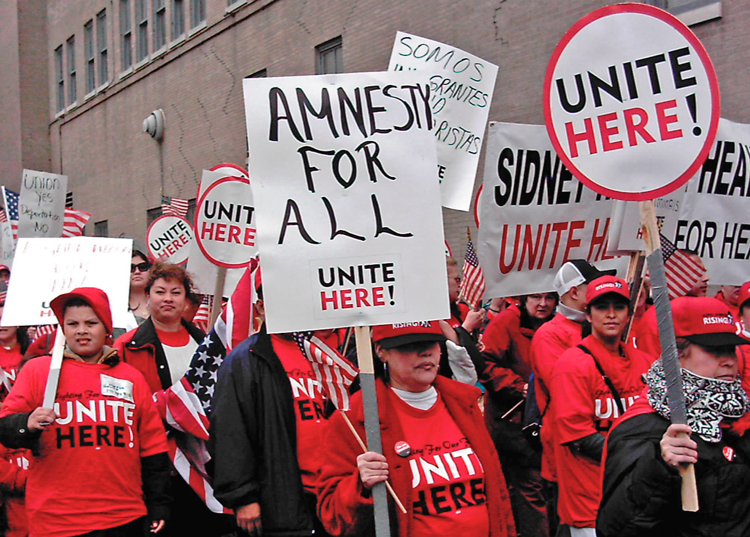
There is a powerful precedent for this. In 2006 more than 2 million immigrant workers and others in over 140 cities and towns took to the streets all across the country on May Day, marching behind banners saying, “We are not criminals! We are workers!” They took off work and went into the street, backed by neighbors and co-workers. They inspired workers from all walks of life to join in and succeeded in beating back the notorious Sensenbrenner bill, which would have made it a felony to be in the U.S. without “papers.” They dealt blows to anti-immigrant prejudice.
Our unions taking the lead in a fight for amnesty would strengthen today’s strike struggles. It would advance workers’ understanding that we all have common class interests — wherever we were born. Our interests are sharply counterposed to those of the capitalist rulers and their political parties. Such a movement will advance the unity of working people and our capacities to act in our tens of millions, to make gains against those who seek to exploit and oppress us and lay the groundwork for taking political power into our own hands.
The bosses’ superexploitation of immigrant workers — a fact of life worldwide today — is vital for their profits. Governments serve the bosses by turning immigration on and off to meet their production needs. The anti-immigrant prejudices the U.S. rulers promote echo the chauvinistic appeals they make to drag workers to serve as cannon fodder in Washington’s imperialist wars abroad.
Raids and deportations under both Democratic and Republican administrations are not intended to stop bosses from hiring immigrants. Their aim is to create a pariah layer of the working class with less protections from exploitation, and that works and lives in fear. They’re aided by liberals, who tell immigrant workers to stay at home and lock the door, while they appeal to Democrats for help. This weakens the building of a movement like the one that exploded in 2006, one that pointed to the fighting capacity of a united working class.
Earlier this year, disciplined, union-backed protests to defend immigrants drew thousands in Minnesota. Rallies in several cities in the past month have demanded a halt to the administration’s drive to end Temporary Protected Status for refugees from Haiti, Venezuela and over a dozen other countries living and working in the U.S.
Tens of millions of workers — native-born and immigrants — have lived, worked and sent their children to school together for decades. We bristle at those who tell us workers without “papers” are our enemy.
The stakes in the political battle against government and boss attacks on immigrants involve the future of the labor movement, “much like the fight against Jim Crow segregation did in the 1950s and 1960s, and as the ongoing fight against all forms of racism and discrimination still does,” Socialist Workers Party leader Mary-Alice Waters explains in the book Is Socialist Revolution in the US Possible?
The fight for an amnesty will also transform social relations and prospects for advancing working-class struggles. Join and use the actions on May Day as a step to turn this into an ongoing battle!