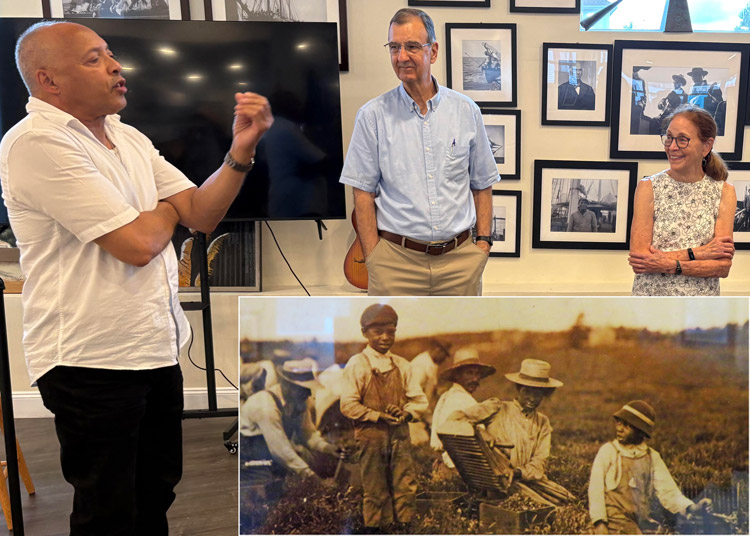
PAWTUCKET, R.I. — The Cape Verdean Museum here is unique. Its displays of photos, posters, crafts and publications, almost all donated by community members, give a vivid feel for the experiences of many generations of immigrants from that West African island nation.
The museum documents the proud history of Cape Verdeans — going back to the early 19th century — who worked on U.S. whaling ships, as cranberry pickers and as unionized construction workers, settling in towns across Massachusetts and Rhode Island. Exhibits show their participation in working-class and other social struggles.
Displays illustrate the independence struggle in Cape Verde and Guinea-Bissau against Portuguese colonial rule. They include documents from the independence movement and a prominent painting of its central leader, Amílcar Cabral.
On June 28 the museum hosted a presentation of Cuba and the Independence War in Guinea-Bissau and Cape Verde: The Fall of the Last Colonial Empire in Africa, by Cuban revolutionary leader Víctor Dreke. The book, published by Pathfinder, is available in the museum library. (See article on the event in the July 20 Militant.)
‘So we can tell our own history’
“Everybody put in their little piece, so we can tell our own history,” Joe DaMoura, the museum’s executive director, proudly told the Militant.
From maps, hooks, and other tools used by sailors on the whaling boats in the early 1800s, to records of arriving immigrants and their mutual aid societies, to the wooden scoops for harvesting cranberries, the exhibits give a glimpse of the life and culture of Cape Verdeans on both sides of the Atlantic.
Volunteer museum guides tell visitors the story of the thousands of Cape Verdeans who came to the U.S. escaping chronic drought, famine and other colonial hardships. Many came on “packet boats,” whaling vessels repurposed after the decline of that industry in the 1920s to take passengers, mail and supplies between the U.S. and Cape Verde.
A glass case contains letters sent to families back home. A “dry” letter contained only greetings and news, explained museum founder Yvonne Smart, currently its education coordinator and curator. A “wet” letter had money in it. The names alluded to Cape Verde’s history of droughts. “We called it a wet letter because it was symbolic of the rain. When you have rain, you have hope and prosperity.”
“My grandfather was one of those who came in the packet boats,” said volunteer guide Al Gomes. “He arrived in 1910 and worked in the cranberry bogs. He was drafted into the U.S. Army when World War I broke out, served in the all-Black 367th Massachusetts Infantry Regiment, and survived the trenches in France.”
A retired union construction and shipyard worker himself, Gomes pointed to photos of members of Local 1329 of the International Longshoremen’s Association, the first predominantly Cape Verdean and Black labor union in New England, founded in 1933. They show the union taking part in Labor Day parades and union picnics.
Support to independence struggle
Smart, like other Cape Verdean Americans of her generation, was active both in supporting the African anti-colonial struggle and in the civil rights battles in the U.S. in the 1970s.
The fight against Portuguese colonial rule had a big impact within the Cape Verdean community here, said Gomes. Initially “there was fear and ambivalence among the older generation. But the younger generation was jubilant and excited” — including Gomes himself, who was 14 at the time Portuguese colonialism was defeated in 1974.
“The U.S.-born youth of my age group were getting both sides of the story, from our parents’ generation and from new Cape Verdean immigrants,” he said. Some of the latter described the brutal realities of colonial rule and how they had been drafted into the Portuguese army to fight their own brothers and sisters battling for independence in Angola, Mozambique or Guinea-Bissau.
The museum also features exhibits on the transatlantic slave trade, the diverse music styles of Cape Verde, and textiles of historic and cultural significance. One exhibit highlights the Jewish roots woven into the country’s rich cultural fabric, a heritage many Cape Verdeans speak proudly of. Jews first immigrated to the islands in the 16th century, fleeing the Inquisition in Spain and Portugal, and a second wave came from Morocco in the 1800s.
The latest addition to the exhibits celebrates Cape Verde’s national soccer team, the Blue Sharks, who in this year’s World Cup became the smallest nation to reach the knockout stage.
Expressions of pride in this rich history and culture were on display at this year’s July 5 Cape Verdean Independence Day celebrations in several towns in the region. The Cape Verdean Museum had a prominent role at the festivities in Providence.
Members of the Socialist Workers Party joined local residents at the celebrations in both Providence and New Bedford. They set up literature tables that drew interest in books on revolutionary working-class politics. Dozens picked up copies of the new book by Víctor Dreke, as well as other titles on African liberation struggles and the Cuban Revolution.
To learn more about the museum in Pawtucket, visit capeverdeanmuseum.org.