OAKLAND, Calif. — “This is an important book,” Brando Williams told listeners to his Peralta Community College radio show, “The Bottom Half,” Aug. 27, here. Williams was referring to Cuba and the Independence War in Guinea-Bissau and Cape Verde: The Fall of the Last Colonial Empire in Africa, by Cuban revolutionary leader Víctor Dreke. It’s published by Pathfinder Press.
Williams got the book from Margaret Trowe, the Socialist Workers Party candidate for California governor, when he interviewed her before the state’s primary election in June. Trowe had asked him to consider doing a spot on the title. He soon told her he liked the book and invited her back to tell listeners why it was worth reading.
Trowe said the book is about the internationalist solidarity provided by Cuba’s revolutionary leadership to the independence struggles that brought down Portuguese colonial rule in Africa.
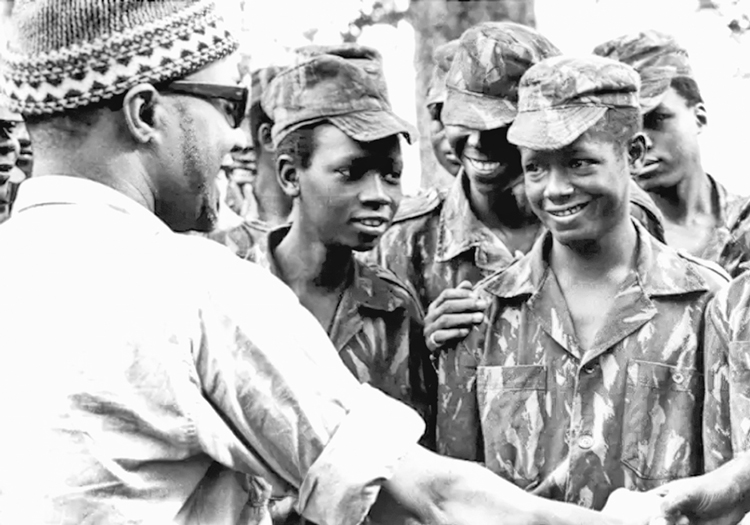
Dreke headed Cuba’s military mission collaborating with fighters for independence from Portuguese rule in Guinea-Bissau.
“The 41-year fascist dictatorship in Portugal fell in 1974 in large part because of the blows dealt by the successful independence struggles of its colonies in Guinea-Bissau and Cape Verde, which then led to independence in Angola, Mozambique, São Tomé and Principe,” Trowe said. “Those struggles succeeded with the solidarity extended by the Cuban revolutionary leadership.”
Williams noted that the Cubans had worked with the Guineans and Cape Verdeans “with respect.”
Trowe described Amílcar Cabral, the central leader of the African Party for the Independence of Guinea-Bissau and Cape Verde (PAIGC), as a world-class revolutionary who looked to the Cuban Revolution as an example. In the book, readers learn how Cabral won the active participation of growing numbers of people to the independence fight.
Trowe said Cabral recognized that the enemy they faced was the Portuguese colonial rulers, not the workers and farmers in the ranks of the Portuguese army. The PAIGC treated them humanely when they were captured.
“The book helps working people understand why Washington is so determined today to destroy the Cuban Revolution and the example it sets,” Trowe said. Cuba’s record of assistance to anti-colonial freedom struggles in Africa and elsewhere is the opposite of the false claims made by the State Department in its July report, “Cuba: The Capital of 21st Century Communism,” she pointed out.
The government alleges Cuba is dedicated to “the violent export of communism abroad” and that “for nearly seven decades the Cuban regime has waged a sustained campaign of subversion against the United States.”
“In fact, it is U.S. imperialism that has been trying to destroy the Cuban Revolution under every administration, Democratic and Republican, since Eisenhower,” Trowe said.
The SWP calls for defending groups “that have been subpoenaed by the government for the ‘crime’ of supporting the Cuban Revolution,” she said. “This is an attack on constitutional protections, including freedom of speech and association. Working people and our organizations have a right to disagree with U.S. foreign policy.”
Williams was interested that Trowe is still campaigning as a write-in candidate after being eliminated from the race under the state’s rules that permit only the top two primary candidates to advance to the November ballot. He told listeners they can still write in her name on the ballot.
Trowe said SWP campaigners are utilizing her campaign to get the truth about the Cuban Revolution to working people on their doorsteps, at strike picket lines and during other working-class struggles.
“We have been talking to workers on strike at Marathon oil in Martinez and at C&H Sugar about the combined character of the U.S. rulers’ wars abroad and the war against working people and unions in the U.S., including the fight for amnesty to end the illegal status of immigrants working in the U.S.,” she said.
Trowe encouraged listeners who want to learn more about the SWP to get in touch. “The SWP believes working people can and must take power to end the capitalist rulers’ drive toward another world war,” she said. “SWP members are active in the industrial unions, oppose U.S. wars, join fights against Jew-hatred and point to ways to unite working people on an international level to defend our own class interests.”
Williams asked Trowe how people can get the book. She gave the details for the SWP campaign headquarters, as well as the Pathfinder Press website.
He thanked her for the interview and said, “Let’s do this again.”