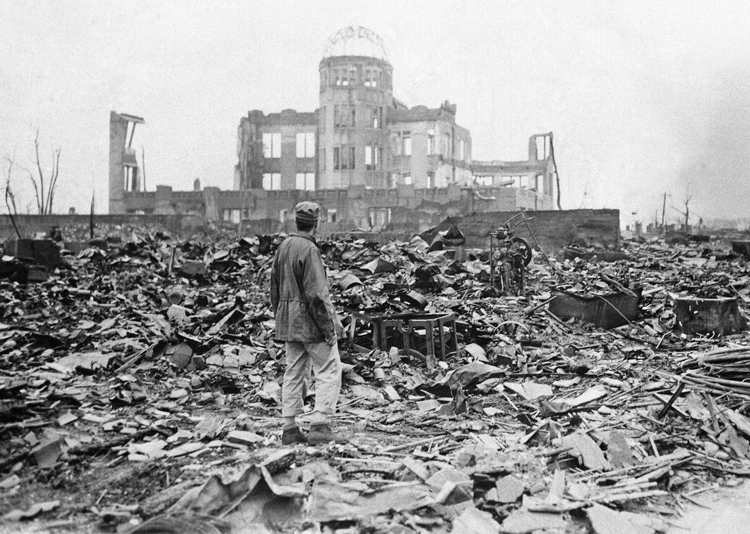
This month marks the 80th anniversary of the U.S. rulers’ atomic bomb slaughter of Hiroshima and Nagasaki, Japan, Aug. 6-9, 1945, killing more than 200,000 men, women and children at the end of World War II. Tens of thousands more died afterward from radiation poisoning and cancers. It’s a grim reminder of what the imperialist rulers in Washington can and will do. And so will its rivals.
Close to 85 million workers’ lives were sacrificed during the war, as the wealthiest and mightiest ruling classes fought to be the winner in their redivision of the earth.
“War is the end result of the ceaseless capitalist hunt for profits, markets, colonies, spheres of influence,” a 1945 Socialist Workers Party National Committee statement explained days after the U.S. rulers bombed Hiroshima and Nagasaki. “It is a lie that war can be prevented by treaties and agreements among the imperialist bandits.”
In the years leading up to World War II, the SWP campaigned for the unions to take the lead in explaining the stakes for working people in opposing the U.S. rulers’ entry into the conflict. For their efforts, 18 leaders of the party and Midwest Teamsters union were sent to prison.
During the war, the Nazi regime in Germany carried out the Holocaust against Jews in their millions, while the capitalist rulers in the U.S., the U.K. and elsewhere slammed shut their doors to Jewish refugees attempting to flee. They refused to bomb the rail lines to the death camps, which could have saved the lives of tens of thousands of Jews and others. Instead, they used every weapon at hand to wipe out their competitors with no regard whatsoever for the fate of civilians.
Firebombings were carried out by London and Washington in a systematic slaughter of civilian populations in Germany and Japan.
On July 24, 1943, British and U.S. air forces launched a 10-day-long campaign — Operation Gomorrah — to wipe out Hamburg, Germany, home to more than 600,000 people. Waves of bombs and incendiary devices created a firestorm that sucked up the air and oxygen, generating winds between 120 and 170 mph, and heat that melted glass and turned bricks to ash. Some 40,000 people died.
Dresden was attacked on Feb. 13, 1945. In a short window of 15 minutes, U.S. and British aircraft unleashed 880 tons of bombs on the city’s center. More waves of bombers followed, dropping incendiary devices.
“People’s shoes melted into the hot asphalt of the street, and the fire moved so swiftly that many were reduced to atoms before they had time to remove their shoes,” U.S. historian Donald Miller wrote. Some 35,000 people were killed. Dresden continued to burn as it was bombed for weeks.
In Japan, bombs and incendiary devices dropped by Washington on Tokyo, on March 9, 1945, killed at least 80,000 people. Almost 16 square miles of Tokyo were destroyed and 1 million were left homeless. The Japanese later called this the “Night of the Black Snow.”
Civilians targeted in war
The U.S. bombings that continued across Japan until the end of the war targeted industrial, military, and civilian targets alike. A deputy to Gen. Henry Arnold, who commanded the U.S. Army Air Forces, later testified, “It made a lot of sense to kill skilled workers by burning whole areas.”
On Aug. 6, U.S. planes dropped “Little Boy,” a uranium-based atomic bomb with the explosive capacity of 15,000 tons of TNT, on Hiroshima. It killed 140,000 people and razed 70% of the town’s buildings.
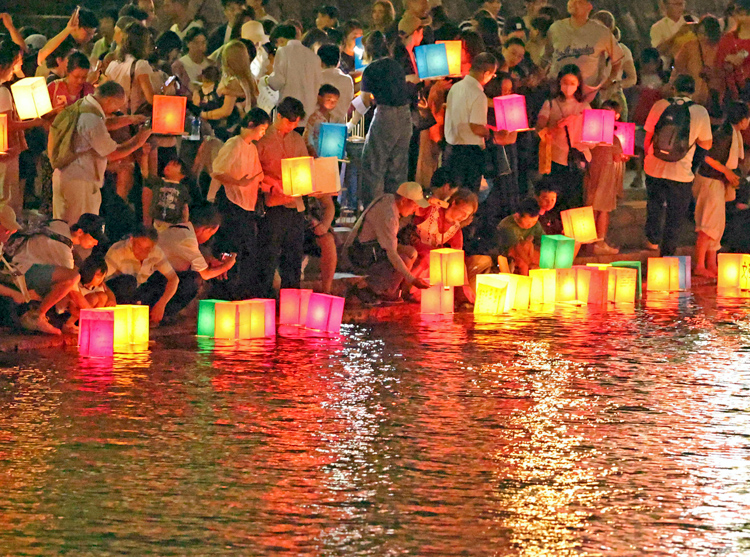
Three days later, “Fat Man,” a slightly larger plutonium bomb, was dropped on Nagasaki, killing 74,000 civilians.
“Capitalism in its death agony is dragging humanity down into the abyss,” SWP National Secretary James P. Cannon said in a speech shortly after the atomic bombs were unleashed. U.S. imperialism has “brought on itself the fear and hatred of the whole world.”
Today, the growing number of capitalist governments possessing nuclear weapons and the intensifying conflicts between them makes it inevitable that these weapons will be used again, if the rulers are not stopped. As during the buildup to World War II, capitalist powers are rearming, trade conflicts are rising and Jew-hating violence is being embraced by reactionary forces worldwide.
“There Is No Peace!” was the banner headline on the Aug. 18, 1945, issue of the Militant at the war’s end. For the last 80 years working people worldwide have lived with this reality of the imperialist epoch.
These deadly destructive forces, held in the hands of the criminal capitalist classes, will be used to decimate humanity unless they are taken from them. Only when the working class takes power into our own hands in the U.S. and in a growing number of other countries worldwide can we stop this carnage.