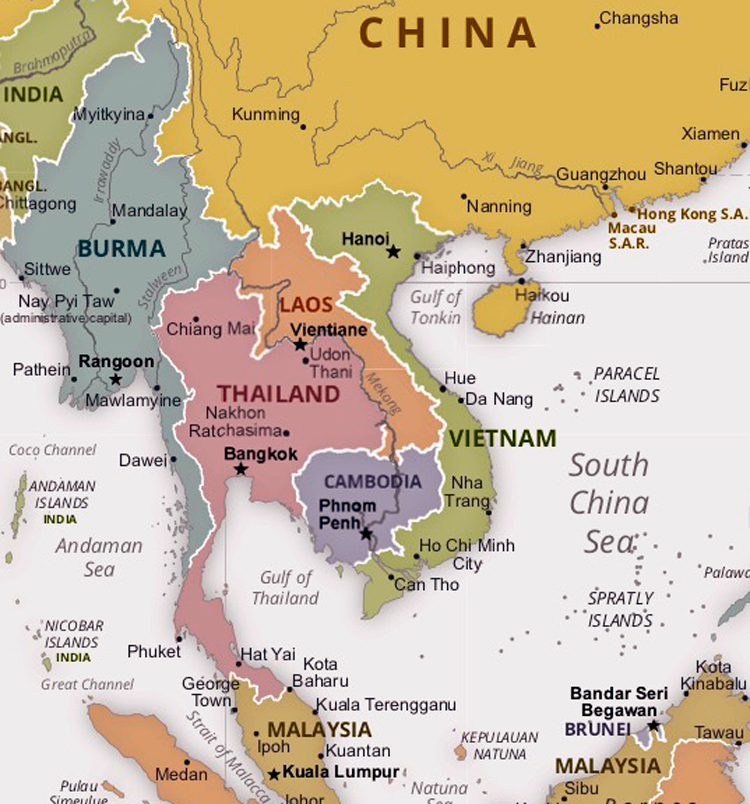
Under growing pressure from Washington, the governments of Cambodia and Thailand signed a ceasefire July 28, after five days of deadly military clashes. The conflict is over longstanding, disputed borders imposed by the colonial rulers of France and the United Kingdom in 1907. This underlying dispute is unresolved.
The July 28 truce was agreed after President Donald Trump threatened to end trade talks with both governments and impose a 36% tariff on each country.
The capitalist governments of Thailand and Cambodia accuse each other of initiating the conflict that spread to six different areas on the border, with military attacks killing 43 people. Some 400,000 Cambodians working in Thailand returned home.
Tensions had sharpened after Thai forces shot dead a Cambodian soldier in May. The rulers in Cambodia halted the import of Thai fuel, fruits and vegetables, and banned all Thai movies and TV shows. The Thai government stopped almost all traffic along the 500-mile-long border, before sealing it completely July 24.
French colonists impose border
At the outset of the imperialist epoch in the early 20th century the French government had seized control of Indochina, including Cambodia, Laos and Vietnam. Its main rival for the domination of Southeast Asia was the British rulers, who controlled neighboring Burma and the Malay Peninsula. As the two colonial powers looked to consolidate their empires, Thailand, then known as Siam, was caught between them.
The French and British agreed not to go to war over Thailand and that the French would set Thailand’s border with Cambodia, which they did with little regard for the history of the region.
The rulers of both Cambodia and Thailand have disputed this border, especially in a number of areas that are sites of ancient temples.
The dispute has festered for decades in a region shaken by the U.S. rulers’ war in Vietnam, including its 1970 invasion of Cambodia, and by Beijing’s 1979 invasion of Vietnam.
The dispute has also become a political issue among the different class forces within each country.
Thailand has two competing houses of government that exist in perpetual friction, a monarchy, largely backed by the military, and an elected prime minister and legislature. In both Thailand and Cambodia the heads of the government have come from the same families for decades. Until recently, the two families have had cordial relations.
Following an exchange of gunfire between the two sides’ armies in May, Hun Sen, the former Cambodian prime minister, leaked a phone call between his son, Hun Manet, the country’s current prime minister, and Thai Prime Minister Paetongtarn Shinawatra. Shinawatra is heard calling Hun Sen “uncle” and criticizing her own country’s military.
The leak of the call sparked outrage from Shinawatra’s political opponents, leading Thailand’s constitutional court to suspend her from office July 1.
Her father, Thaksin Shinawatra, a wealthy businessman, is also a former Thai prime minister. He was overthrown in a 2006 military coup backed by Thailand’s king, Bhumibol Adulyadej. Thaksin Shinawatra will go on trial Aug. 22 for insulting the monarchy, a charge that could lead to up to 15 years in prison.
Cambodia’s Hun Sen was prime minister for nearly four decades. His Cambodian People’s Party holds all the seats in parliament, after the opposition Cambodian National Rescue Party was forced to disband in 2020.
Hun Sen is a former officer in the Khmer Rouge, the Stalinist group that ruled the country between 1975 and 1979. Under its reign of terror up to 2 million people were killed, cities evacuated and the population sent to forced labor camps in the countryside in an imitation of the anti-working-class policies pursued by Mao Tse-tung’s regime in China.
Washington-Beijing conflict
In recent years successive governments in both countries have sought to deepen relations with Washington, the world’s dominant imperialist power, and with Beijing, the U.S. rulers’ primary competitor and the largest trading partner of both Cambodia and Thailand.
The Thai government has been historically allied with Washington and depends on the U.S. rulers for supplying its military. Thai forces co-host the annual Cobra Gold joint military exercises with the U.S. Army, the largest war games the Pentagon organizes in the Indo-Pacific region.
In contrast, Cambodia’s rulers have long-held ties with Beijing. The armed forces of Cambodia and China hold annual joint Golden Dragon exercises. This year’s was touted as the largest ever and involved live-fire training. Beijing began upgrading Cambodia’s Ream Naval Base in 2022, heightening fears in Washington it will eventually serve as a Chinese overseas military outpost. The U.S. rulers imposed an arms embargo on Cambodia in 2021.
With the opposing territorial claims unresolved, amid the clashes between Washington and Beijing, tensions between the rulers of Thailand and Cambodia will continue to simmer.