
MONTREAL — In a strong pushback against Canada Post bosses and Prime Minister Mark Carney’s Liberal government, close to 70% of Canada’s 55,000 postal workers rejected the bosses’ “final” contract proposal. The results were announced Aug. 1, after members of the Canadian Union of Postal Workers were forced to vote again by the government.
The proposed contract included most of the concession demands workers rejected by over 95% last October, along with a wage increase of only 13% over four years. Many workers considered this proposal insulting.
“I’m really, really happy and proud that my colleagues voted against it,” Kim Scharley told the Militant Aug. 3. Scharley works as a sorting clerk at the massive mail distribution plant in the St. Laurent borough of Montreal.
“We stood up to a fierce coercive fear campaign by Canada Post management of emails and text messages trying to get us to vote yes,” she said, “but we weren’t intimidated. Canada Post’s plan backfired.”
Scharley said that since she was hired in 2005, “we have never had the right to strike, because the government has always ordered us back to work while Canada Post has not bargained in good faith.”
“In all the time I have worked at Canada Post, my wages have never kept up with the rate of inflation,” she added.
The vote also reflected workers’ reaction to the deteriorating and increasingly unsafe working conditions workers face, as Canada Post drives to boost productivity and profits.
“Postal workers suffer the second-highest rate of disabling injury among workers under federal jurisdiction,” CUPW National President Jan Simpson said last December.
Militant worker-correspondents talked to some workers at the St. Laurent plant who were considering voting “yes,” but not because they think the proposed contract meets their needs. They said they didn’t think there is anything they can do in face of the government’s support for management and the fierce anti-union campaign by the capitalist media.
Attack on right to strike
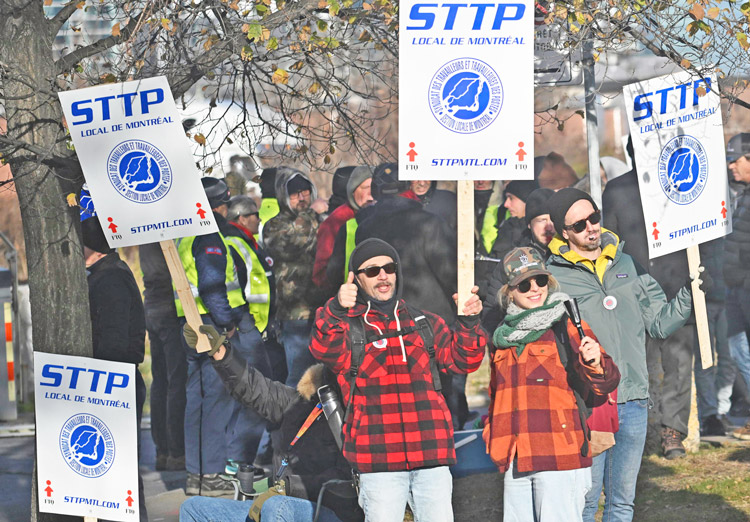
Last November, the Canadian Union of Postal Workers called a national strike to fight for wages that keep up with inflation, for safer working conditions and against Canada Post’s plans to introduce part-time weekend positions at lower pay, second-rate benefits and an inferior pension compared to full-time workers.
After four weeks Ottawa called on the Canada Industrial Relations Board to order the striking workers back to work, extending the existing contract to May 2025. This action union officials called “an assault on our constitutionally protected right to collectively bargain and to strike.”
This kind of anti-union move by the government has become increasingly common over the last year. Ottawa has used the Canada Industrial Relations Board, which it appoints, to order striking rail and port workers back to work, to eliminate negotiations and impose compulsory arbitration. It’s the biggest attack on the right to strike in years.
In this context, Canada Post bosses stalled rather than negotiated and maintained their concessions demands. Ottawa responded by ordering the Industrial Relations Board to force the workers to vote again on Canada Post’s final offer.
The union denounced this undemocratic move as setting a “dangerous precedent” aimed at imposing management’s terms “without our consent.”
Bosses target workers, mail service
In a further attack, Canada Post announced it supports the proposals of a commission established by Ottawa to make the post office profitable. The commission recommends phasing out door-to-door delivery, replacing it with community mailboxes, closing more rural post offices and expanding the use of part-time rather than full-time workers.
The union said these proposals would mean significant cuts in postal services and “major rollbacks” in the jobs, wages and benefits of workers.
Richard Martin, president of the CUPW local in Vaudreuil-Dorion, just west of Montreal, told the Militant that workers are in a strong position to continue their fight because of “the power of their solidarity,” their “collective resolve” and the “support of the entire working class.”
In light of the strong “no” vote, Canadian Union of Postal Workers officials are calling on Canada Post to resume negotiations and for a contract that meets postal workers’ needs. Management has yet to respond to the union’s proposal.
“Working people should stand behind CUPW’s fight for a decent contract, as well as in opposition to further cuts to an essential public service,” Philippe Tessier, Communist League candidate for mayor of Saint Leonard, who works as a conductor at Canadian National Rail and is a member of the Teamsters union, told the Militant Aug. 3.
“Unions across Canada and internationally need to stand with the postal workers’ just fight and oppose any further attacks by Ottawa on the right to strike and other union rights essential for the working class. And to defend ourselves against attacks on our rights by the capitalist governments and the bosses on whose behalf they act.”