American Labor Struggles: 1877-1934 by Samuel Yellen is one of Pathfinder’s Books of the Month for August. The excerpt below is from “The railroad uprisings of 1877.” Known as the Great Strike, it was sparked by starvation wages and brutal working conditions. It started among rail laborers in Maryland and West Virginia, but drew in more than 100,000 other workers, alarming the capitalist rulers. Federal, state and city governments unleashed troops, cops and thugs on strikers. Karl Marx wrote that this mighty class battle “could very well be the point of origin for the creation of a serious workers’ party.” Copyright © 1974. Reprinted by permission from Pathfinder Press.
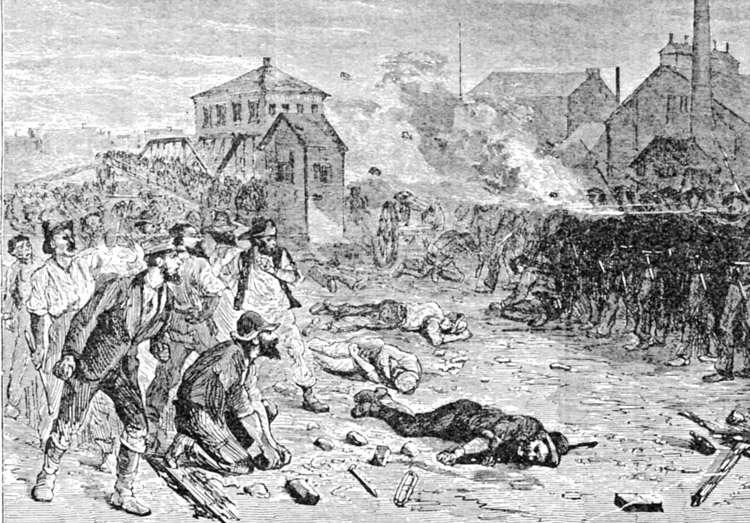
The great railroad strikes which broke out spontaneously and spread with the speed of a plague in the summer of 1877 were the expression of a deep and accumulated discontent. Labor outbreaks had been common in the United States before this time, but had been confined to separate localities. Never before had industry and commerce been confronted with a nation-wide uprising of workers, an uprising so obstinate and bitter that it was crushed only after great bloodshed. The militia of the several states did not suffice; for the first time in the history of the country the federal troops had to be called out during a period of peace in order to suppress strikes. More than a hundred workmen were killed and several hundred badly wounded. For a full week the strikes crowded from the front pages of the newspapers all reports of the war between Russia and Turkey, then in progress, and of the campaign against the Sioux Indians in the Idaho territory. The general public, both workers and employers, became aware that a national labor movement had been born.
Although the strikes were primarily a protest against reductions in wages, they had a more profound origin in the depression that resulted from the panic of 1873. Stimulated by the Civil War, industry and commerce had prospered. For a number of years all kinds of business enterprise had been confidently undertaken. The first transcontinental railroad had been opened in 1869. In the cities, factories had replaced home industry. Immigration had been encouraged and the population had increased. Corporations had sprung up and the foundations for vast fortunes had been laid.
This hectic development, however, had been too rapid and was based too often on the wildest gambling and most corrupt scheming. Furthermore, the financial system of the nation was tottering, since paper money was widely circulated, with no provision for specie payment. When the inevitable crash came, hundreds of thousands were thrown out of employment, and many thousands lacked food, clothing, shelter, medical attention. Even those still at work suffered, inasmuch as wages were cut nearly in half during the next six years. …
The railroads, which had cut wages steadily, prepared for another reduction, in order that freight rates might be lowered. The Pennsylvania Railroad led the way with a 10 per cent cut. … With thousands of jobless men begging for places, the railroad officials felt certain that the workmen, no matter how intense their dissatisfaction, would be afraid to walk out.
But the railroads failed to calculate the sharp popular feeling against them. Farmers throughout the country resented the high, almost confiscatory freight rates. … Workers were sullen because of continued wage cuts and unemployment, and the railroads, as employers of the largest number of men, stirred up great ill-will. Besides, scandals like that of the Crédit Mobilier and the Union Pacific had disclosed to the public a fraction of the bribery, corruption, and financial thieving that had gone into the building of the railroads. …
Aside from the question of wage reductions, the workers had other grievances against the railroads. They were, for example, always subject to call, although there was but three to five days’ work a week. When they were on the job, they toiled excessively long hours, as many as 15 to 18 hours per day. On many roads their pay was several months in arrears. …
Other cities became affected by strikes — Altoona, Easton, Harrisburg, Reading, Johnstown, Bethlehem, Philadelphia — and freight was tied up on the entire road. … Governor [John] Hartranft directed military activities. He instructed his troops to fire into every crowd until it scattered. The rebellion throughout the state was to be crushed at any cost. …
As the strikes moved westward they extended to other industries and in many localities began to assume the proportions of a general strike. Such a situation grew up in Chicago, commencing simply enough with a strike on July 24 at the Michigan Central freight yards. The wave passed from yard to yard, and then to factories and shops, until there prevailed what approached a general strike.
In a subheadline the New York Times announced: the city in possession of communists. The following day the police attacked the strikers with clubs and guns at the Michigan Central freight yards and arrested their leaders; nevertheless the strike spread. All street cars were halted on the South Side. The sailors in the port walked out. A crowd of 8,000 at the Chicago, Burlington and Quincy roundhouse was dispersed only after three were killed and seven wounded. …
Practically all the strikes had been defeated after the two weeks’ struggle from July 16 to August 1, but not before society saw plainly that the land of opportunity, with its traditions of the sanctity of private property and of freedom of contract, had been converted into the battleground for a bitter war between two essentially hostile economic classes. … For the first time in its history the country had been swept by a general-strike movement, and workmen had challenged their employers not as discrete local groups, as a nation-wide mass. …
The dilemma of labor was inescapable, and strikes in their final stage had to contend against all the military and legal force of the nation.
Nevertheless, the moral effect of the strikes upon the working class was invigorating. A new spirit of labor solidarity was born and made national.