In the midst of Washington’s stepped-up economic war aimed at strangling the Cuban people, “Cuban Book Day” was celebrated in Havana and several of the country’s provinces March 31. The events marked the founding of the country’s National Printing House on March 31, 1959.
The printing-program anniversary celebrates one of the landmark achievements of the Cuban Revolution, begun only a few months after workers and peasants took power under the leadership of Fidel Castro.
The first work produced after the overthrow of the U.S.-backed Fulgencio Batista dictatorship was Don Quixote — a bold undertaking. A masterpiece of world literature, the Cuban edition of Miguel de Cervantes’ classic was a four-volume set illustrated by Pablo Picasso and the French artist Gustave Doré, with a print run of 100,000 copies, priced at 25 cents each. The revolutionary government organized to make it available all over the island.
For many workers and peasants in Cuba that was the first opportunity to ever hold a book in their hands, let alone form a library. Its publication was followed by a series of other high-quality, inexpensive and accessible editions of the best of Cuban and world literature and poetry, known as the People’s Library.
The Cuban leadership aimed to give the country’s toilers the tools to run their country. But in order to take control of industry and agriculture, to transform production and the conditions of life and work, taking control of their own destiny, Cubans needed to be able to read and write.
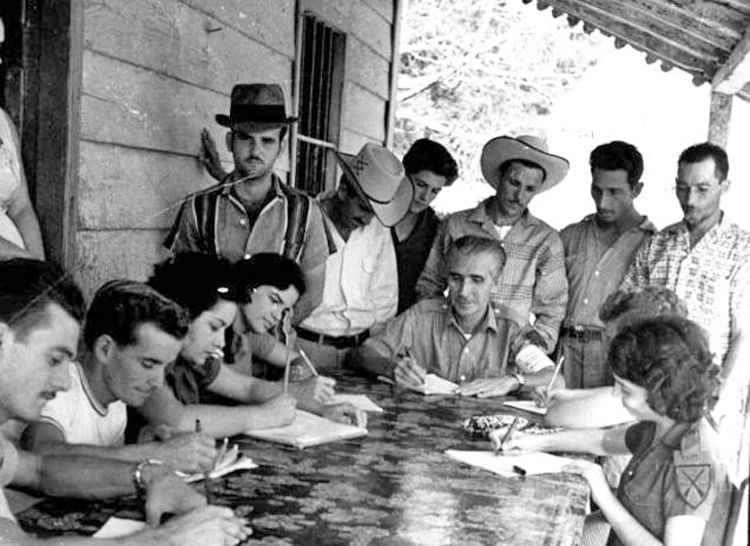
Castro and the July 26 Movement acted on this course even before they took power. In 1958 the Rebel Army reopened 400 primary schools that had been shut down by the dictatorship in the Oriente province territory known as the Second Front.
Combatants who couldn’t read or write were taught alongside school-age children. As the teachers had a “dual function — fighting both ignorance and the existing social order — these educators were called rebel teachers,” said Asela de los Santos, the head of the Rebel Army’s Department of Education in the Second Front. “That experience became the forerunner. It showed what was needed once victory had been won.”
National Literacy Campaign
In September 1960 Fidel Castro told the United Nations, “In the coming year, our country intends to wage its great battle against illiteracy, with the ambitious goal of teaching every single illiterate person in the country to read and write.”
The year 1961 in Cuba was indeed “The Year of Education,” with more than 100,000 volunteers, most of them teenagers, spreading out across the country. They utilized 1.5 million copies of la cartilla, a booklet developed to teach people to read and write that was produced by the National Printing House. Before the year’s end the campaign had succeeded.
In April 1961 Fidel Castro gave a televised speech summing up the revolution’s orientation, “We don’t tell the people: ‘Believe!’ We tell them: ‘Read!’” The National Printing House made it possible for millions of Cubans to access literature.
And eliminating illiteracy laid the basis for other cultural and scientific accomplishments achieved by the Cuban Revolution, unheard of for an underdeveloped country.
The commitment of the revolution to draw the entire people into reading and culture led to the establishment of the Havana International Book Fair, which was launched in 1982. It took place every other year until 2000, when it became an annual occurrence, considered the most important cultural event on the island. Each year hundreds of thousands of Cubans attend the festival, held under the motto “To read is to grow.”
Over time, after the fair in Havana ended, smaller fairs were organize in cities across the country, reaching thousands more.
As Washington has intensified its economic war against Cuba, book production has virtually come to a halt due to the lack of paper and equipment.
A week before the scheduled opening of this year’s book fair, the Donald Trump administration imposed an oil blockade on the island. Cuban authorities were forced to postpone the fair indefinitely and redirect resources to other needs.
Yet Cubans’ love of books hasn’t been diminished. At the Guantánamo celebration of Cuban Book Day, poet Mireya Piñeiro Ortigosa recalled how in Cervantes’ book, Don Quixote attacks a row of windmills, imagining them as gigantic opponents.
“We don’t see windmills,” she said, “we have real monster-like giants closing in on us more and more, but with that same fighting spirit of Don Quixote, we press on, without stopping.”