MONTREAL — Newly declassified Royal Canadian Mounted Police Security Service files have confirmed that in the 1960s and ’70s the Canadian rulers’ top spy outfit systematically infiltrated and sought to disrupt Indigenous and other political groups.
The RCMP program “was very invasive, and no one should have to live with that,” said Georges Erasmus, formerly the Dene Nation president and national chief of the Assembly of First Nations.
“It’s really shocking and it’s unacceptable that Canada would target, harass and spy on our people,” the current Assembly of First Nations national chief, Cindy Woodhouse Nepinak, said. She called for an investigation into the covert RCMP operation and a public apology from both Canada’s public safety minister and Prime Minister Mark Carney.
In 1984 Ottawa replaced the discredited RCMP Security Service with the Canadian Security Intelligence Service. The move came after exposure of the former spy force’s illegal activities, including break-ins, theft, arson and frame-ups aimed at disrupting labor unions and Indigenous, black and Quebec independence organizations, as well as other opponents of the government. The RCMP still exists, acting as the Canadian political police.
After the Canadian Broadcasting Corporation ran a special series on the newly released RCMP Security Service files and the outrage that followed by Indigenous organizations and other targets, a CBC-TV reporter interviewed the deputy director of CSIS, Nicole Giles, March 24, asking her whether it pays informers to spy on and disrupt organizations like the Assembly of First Nations.
She avoided answering directly, effectively confirming the CSIS does use paid informants and other covert tactics against government opponents, just as the RCMP Security Service had done.
The documents, and interviews with former RCMP Security Service members since they were revealed, show that Canada’s capitalist rulers were concerned about the influence of “radicals and communists” on the Indigenous rights movement in Canada, including from the American Indian Movement in the U.S. Others targeted included a group that became today’s Communist League, as well as the Communist Party of Canada and the Communist Party of Canada (Marxist-Leninist).
The CBC obtained the nearly 6,000 pages of RCMP spy files despite efforts by the Liberal government of former Prime Minister Justin Trudeau to use the courts to block their disclosure, which delayed their release for years.
The RCMP disruption program was called the “Native extremism program,” intruding on a wide range of groups using wiretaps, paid informants and covert surveillance of homes, offices and elsewhere.
In the mid-1970s the Liberal government approved RCMP wiretaps to monitor the telephones of the National Indian Brotherhood, today known as the Assembly of First Nations. The program evolved into a massive countrywide surveillance operation.
The files include hundreds of surveillance reports in folders marked “racial intelligence,” confirming use of illegal clandestine methods. Black rights organizations and activists were also targets.
Armed attacks
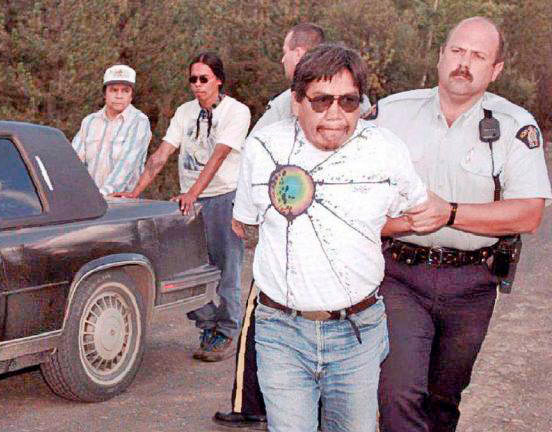
This operation escalated into armed attacks on Indigenous organizations and activists. In the summer of 1990, Ottawa sent 900 soldiers in full battle gear against Mohawk communities in Kahnawake and Kanesatake, near the Town of Oka outside Montreal, equipped with heavy weapons that included machine guns, armored personnel carriers and helicopters. The Mohawks’ crime? They had erected a barricade to protest the expansion of a golf club onto their Native land.
In 1995 some 400 RCMP cops, collaborating closely with CSIS and the Canadian army, attacked 30 Indigenous activists who were carrying out a land occupation in Gustafsen Lake, British Columbia.
Less than a week later, heavily armed Ontario Provincial Police attacked unarmed Indigenous protesters who were occupying land in Ipperwash that had been taken from them by the federal government during World War II. One Native activist, Dudley George, was killed by an Ontario police sniper.
Joe Young, the Communist League candidate in October’s Quebec elections, is campaigning on the importance of these revelations, which show that Ottawa’s political police are a threat to political rights. “The latest exposure of the covert operations of both the RCMP and CSIS underlines the necessity of the unions and other defenders of political freedoms to fight against every attack on the rights working people need to defend our class interests,” he said, “as the capitalist rulers prepare for new and deadlier wars abroad and step up their attacks on working people at home.”