While millions of people in Cuba demonstrated in defense of the country’s sovereignty and socialist revolution May 1, the U.S. capitalist rulers imposed a new round of punishing sanctions, intensifying their efforts to topple the government.
President Donald Trump’s administration issued an executive order that day broadening sanctions against Cuban entities, and for the first time threatened non-U.S. individuals, entities and affiliates conducting business in the “energy, defense and related materiel, metals and mining, financial services … or any other sector of the Cuban economy.”
For nearly seven decades, under both Democratic and Republican administrations, the U.S. rulers have tightened brutal measures aimed at suffocating economic, political and social gains the Cuban people made through their socialist revolution. Washington has prohibited U.S.-owned businesses and their subsidiaries subject to U.S. jurisdiction from trading with Cuba. It has banned them from selling goods and services to Cuba, or importing goods from third countries to the United States that contain Cuban materials, like nickel used in machinery and equipment, pharmaceuticals and even sugar.
The May 1 executive order targets key sectors of Cuba’s economy in which foreign investments have expanded in recent years, Ariadna Cornelio of Cuba’s foreign ministry said on Cuba’s national television May 5.
Washington imposed an oil blockade at the beginning of the year that has severely aggravated hardships on working people across the island, and “now, because of Cuba’s decision to seek other ways to achieve energy self-sufficiency, they are going after the whole energy sector,” said Cornelio.
The measure’s extraterritorial effect was felt right away when Canada’s Sherritt International Corp. decided to pull its operations from a nickel and cobalt mining joint venture with Cuba’s General Nickel Company. The Canadian company is one of Cuba’s top foreign investors, and the industry is a critical source of revenue for the Cuban state.
Cuba’s Moa Nickel SA was one of the sanctioned entities targeted by Secretary of State Marco Rubio May 7, along with Grupo de Administración Empresarial (GAESA). GAESA is a business conglomerate with ties to Cuba’s armed forces that runs many of the island’s hotels and other businesses. It accounts for roughly 40% of Cuba’s gross domestic product.
Rubio claimed the brutal sanctions do not affect the Cuban people. However, Cuba’s earnings from sales of nickel and other products, tourism and compensation for medical cooperation with other countries are what pays for essential fuel and food imports, social spending and development investments. Without them working people will face even greater shortages of food, medical supplies and other essentials.
To face the crippling effect of the U.S. oil blockade, the Cuban government has taken measures to accelerate the development of solar power and increase domestic crude production. In addition to large-scale infrastructure, state institutions, farm cooperatives and private small businesses have turned to alternative energy sources at a rapid pace. One of Washington’s aims in threatening sanctions is to intimidate anyone from supplying or donating energy technology to Cuba.
Millions of dollars-worth of solar panels have been installed in clinics, homes for the elderly, radio and cellphone stations and other critical services. Solar-powered irrigation pumps are being deployed on tobacco and other farms.
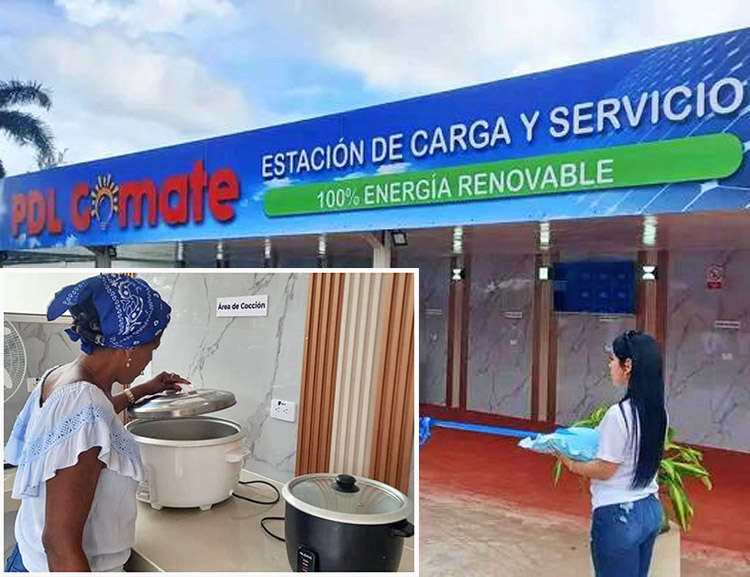
A solar-powered charging station, or “solinera” (a play on the word “gasolinera,” gas station in Spanish), opened in Santa Clara, in central Cuba, bringing relief to residents facing chronic blackouts caused by the oil blockade. The solinera, the first of its kind, offers a free charge for cellphones, power batteries, rice cookers, pressure cookers and an endless array of appliances that people bring. Rechargeable motorcycles and three-wheeled vehicles can also be charged for a fee. While the gap between what’s needed and what can be supplied remains large, local projects like this one are emerging everywhere. Renewable energy now accounts for 10% of the island’s power.
US tramples on sovereign rights
Washington’s measures “put the international community in a big dilemma,” said Cuban Foreign Minister Bruno Rodríguez at a May 2 international solidarity event in Havana, the day after the massive workers’ actions. “In the face of these acts no single state will be able to exercise the sovereignty of their peoples, if today they don’t take the side in favor of justice, in favor of Cuba.” He pointed to the U.S. rulers’ increasing use of its military and economic power around the world, including against Cuba.
The solidarity event — sponsored by the Central Organization of Cuban Workers (CTC), and the Cuban Institute for Friendship with the Peoples — was attended by more than 750 trade unionists and members of political organizations from 36 countries. Among them were organizations involved in collecting donations for the purchase of solar panels, medical and other critical supplies for the Cuban people. The gathering was also addressed by Cuban President Miguel Díaz-Canel and CTC leader Osnay Colina Rodríguez.
“In Cuba we are defending the sovereignty, independence and right to self-determination of the peoples,” said the Cuban president. It is “the U.S. government that every day speaks of war and makes threats.” He was answering Washington’s charges that Cuba constitutes an unusual and extraordinary danger.
“It seems that the May Day demonstration bothered them,” said Díaz-Canel.