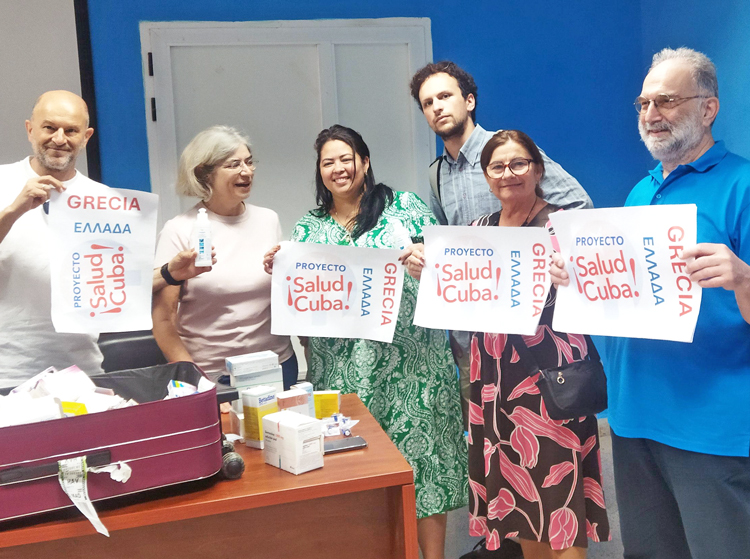
ATHENS, Greece — Some 35 people packed the meeting hall of the Athens publishing house Diethnes Vima April 18 to hear a report from a union delegation returning from Cuba. The group of four was organized by unionists at Athens International Airport. They took with them much-needed medical supplies gathered through the local “Proyecto ¡Salud Cuba!”
Over 30 transport workers, teachers and students contributed funds to make the trip possible. Hundreds more, including several pharmacists, gathered nearly 450 pounds of donations to take to Cuba.
“We visited five hospitals to deliver medical supplies we brought, and what impressed us was that despite a severe lack of medicine and power interruptions, the staff was giving their all to save lives,” university student Lambros Katsaros said. “There is a real dynamism to these workers who are often quite young. They work their way around shortages as best they can.”
Panagiotis Katsaros, president of the union at DHL in Athens, told the meeting about the delegation’s meeting with Osnay Miguel Colina Rodríguez, general secretary of the Central Organization of Cuban Workers (CTC), as well as leaders of the National Energy and Mine Workers Union (SNTEM).
“Workers are facing the most challenging and complex situation since the beginning of the Cuban Revolution, Colina told us, and workers are at the vanguard of finding solutions and defending Cuba and the revolution,” Katsaros said. The CTC has been organizing workers whose factories aren’t working to capacity to cultivate plots of land near their workplaces. This is happening near the airport as well.
Efraín Benítez Machirán, from the secretariat of SNTEM, said the power cuts are not only due to the oil blockade, but to the fact that “for years we have not had access to spare parts and the opportunity to modernize” due to Washington’s longstanding sanctions against Cuba. “Diverse forms of energy are being combined to serve the national power grid, a demanding operation that requires workers’ ingenuity,” he said.
“The unionists we met with helped bring home to us what it means that workers are in power in Cuba,” Katsaros said. “Imagine, unions there are not fighting against the owners, the government and anti-labor laws. They make the laws!”
The delegation was welcomed to the Cuban Institute for Friendship with the Peoples by its president, Fernando González. Vice President Noemí Rabaza told them Cuba is getting international solidarity, but “the people of Cuba are preparing and organizing to resist with the resources that they have.” Rabaza outlined the government’s plan to increase domestic crude oil production and develop ways to refine it, repair old power plants and incorporate renewable forms of energy into the electrical grid.
The delegation met with Gerardo Hernández, national coordinator of the Committees for the Defense of the Revolution (CDR), and participated in a Saturday morning neighborhood cleanup, organized by the CDRs in the Romerillo district.
“After the job was done, Estela, the local CDR president, invited us into her home to chat and clean ourselves up,” delegation member Natasha Terlexi, who had been a longtime unionist at the Athens airport, told the meeting. “She showed us her vegetable and herb garden and the cistern in the back of her house for water. Her message was: ‘Yes, things are hard, but this is more of the same. We survive day to day by helping one another. We have confronted our neighbors to the North before and won before, and we will do it again.’” This grandmother of two, like many others the delegation spoke to, said she’s determined to do her part to defend the revolution.
While Terlexi was talking with a working-class couple, Maite and Lino, from San Miguel, a few people in the area tried to start a pot-banging protest. The power in the Romerillo district had been off for over 17 hours. “Two or three people from a building across the street joined in, but most people just went about their business,” she said. “The visitors from San Miguel said they don’t deal with the outages that way in their neighborhood. People work together and help each other. And the CDR organizes impromptu cultural events.”
“Colina emphasized that in Cuba, the working class exercises political power,” Bobbis Misailidis, a long-time union activist at DHL cargo, said. “All developments — the imperialist blockade, the dire situation facing the Cuban people, and their resistance to the intensifying attacks by the imperialists — must be understood within this context.
“We didn’t see a ‘failed state,’ in Cuba,” Misailidis said, “We saw working people constantly finding ways to defend and improve the gains they made since 1959. It is this people that the imperialists fear and underestimate, just like bosses underestimate the working class here and in other capitalist countries.
“They fear we will follow the example of the Cuban Revolution, which shows that we can build a society based not on cutthroat individualism, but on dignity, selflessness, honesty, love and human solidarity,” he said. “These are the moral values of José Martí that influenced the generation of Fidel who led the revolution.”
A lively discussion followed. Cuban Ambassador Aramis Fuente Hernández closed the event by speaking more about what the revolution had accomplished, and how they have met the U.S. rulers’ attacks for 67 years.
He urged participants to reach out and strengthen solidarity with Cuba in every way we can.