On April 26, 1986, an explosion and a 10-day fire destroyed reactor No. 4 of the Chernobyl power plant in Ukraine, then part of the Soviet Union, unleashing the world’s worst nuclear catastrophe to date. The bureaucratic Stalinist regime in Moscow was responsible for this deadly disaster and tried to cover it up, jeopardizing the safety and lives of millions.
Moscow’s four-year brutal invasion of Ukraine has revived fears that this nuclear danger is far from over. Russian troops occupied the Chernobyl site briefly in 2022, churning up its radioactive dust. Despite a supposed ceasefire, two Russian drones crashed in a forest in the Chernobyl exclusion zone May 8, setting off a large wildfire. Ukrainian firefighters working to contain the blaze were impeded by Russian drones overhead and mines or munitions left behind four years ago, as Moscow’s forces there were pushed out of Ukraine.
A Russian drone scored a direct hit on the reactor site Feb. 14, 2025. It punctured a sizable hole in the huge dome installed in 2019 to contain the radioactive remains. A serious fire blazed for days inside, compromising the protective outer shield. (See “40 years on, Moscow’s war risks a new Chernobyl nuclear disaster” in April 20 Militant.)
“When the drone struck the arch, it felt like the world could return to 1986,” Liudmyla Liubyva, 71, told The Associated Press as she attended a 40th anniversary vigil. It has been held annually in nearby Slavutych, where hundreds who still work at the Chernobyl plant live. Her husband, a former worker at Chernobyl, can no longer attend, having lost his ability to walk after heavy radiation exposure. “We all — young and old alike — must protect our land, because it is so vulnerable.”
The Soviet design of Chernobyl’s nuclear reactors lacked basic safety features, including a protective outer shell to contain any radiation leak, let alone an explosion. Moscow was callously indifferent as thousands of the plant’s workers and all its volunteer firefighters, with little or no protection, selflessly fought to contain the radioactive fire. Scores died within months or in the following years, with many more suffering radiation poisoning. Forty years later, few of the first responders still survive.
About 600,000 other Ukrainian workers, mostly volunteers known as “liquidators,” came to Chernobyl to try to clean up and bury the radioactive debris. Many of them were badly affected.
Volodymyr Yakubets told the April 27 Kyiv Post that in 1986 “we did not hear about the accident right away. Maybe on the third day … but it was presented as just an accident, as if nothing serious. Then people began to feel it in their health … people started getting sick a lot.”
Until the radioactive cloud reached Sweden, 800 miles away, and triggered alarms, the Kremlin tried to cover up the disaster. Telling the whole truth about the scale of the disaster was illegal at that time and for years later. Moscow treated working people like cattle, ordering hundreds of thousands to leave with little planning or resources. Soviet doctors refused to diagnose, let alone treat, radiation sickness.
The one country that selflessly came to the aid of the victims of the disaster was Cuba. Fidel Castro responded to a request for help by the Communist party youth there. Cuba created special medical facilities at Tarara where thousands of Ukrainian youth were able to get treatment at no cost.
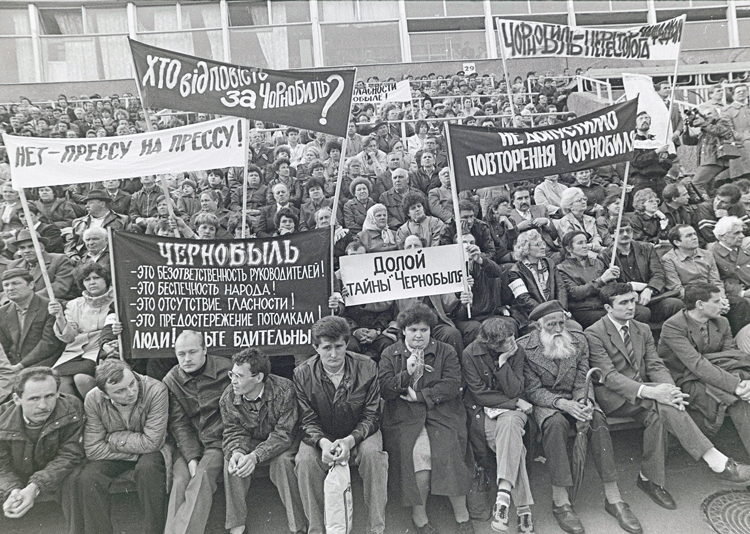
Efrem Lukatsky, a journalist whose pictures have catalogued four decades of the meltdown and its aftermath, told AP April 22 that small tentative protests began to develop as more of the truth about the disaster and its consequences leaked out. These “soon grew into larger demonstrations demanding answers — rallies that in turn formed the nucleus of Ukraine’s independence movement.”
The crisis accelerated the disintegration of the Soviet Union. It impelled rising struggles of working people in the former Soviet republics, especially Ukraine, which led to their independence in 1991.
2014: ‘Militant’ reporters in Ukraine
In 2014, a powerful working-class uprising, with thousands occupying the Maidan Square in Kyiv, overthrew the dictatorial pro-Moscow government of Viktor Yanukovych. Russian President Vladimir Putin responded by seizing Ukraine’s Crimean Peninsula, despite mass protests by the indigenous Crimean Tatar people and other Ukrainians there. The Kremlin infiltrated Russian soldiers to occupy parts of the Luhansk and Donetsk provinces in the east.
In June 2014, a reporting team to Ukraine led by the Militant’s current editor, John Studer, visited the Chernobyl exclusion zone at the invitation of the ATOM Trade Union there. The team met with some of the liquidators, including union rail workers and coal miners, members of the Free Trade Unions of Ukraine.
“The town where we lived before, Pripyat, was uninhabitable because of the radiation,” Viktoria Babek, vice chair of the union, told Studer. “After Chernobyl, people came from all over the former Soviet Union. They built Slavutych and joined in efforts to clean up the area after the disaster.”
Recently Babek, who still works at Chernobyl, shared her memories of living in Pripyat. She told the April 26 Kyiv Post that even though she wasn’t from “a family of privileged party members,” Pripyat wasn’t like any other Soviet city. There were no shortages or queues. But “as soon as it became clear on the 26th that something was wrong,” she said, her mother immediately put her and her sister on the train to Kyiv.
At the request of the nuclear workers union, the Militant team visited Slavutych in 2014 for the town’s 26th anniversary.
The residents there, like elsewhere, were in good spirits because of “the big events in the Maidan,” Sergey Akamovych, a leader of ATOM, told Studer. “Ukrainians are more conscious, more self-confident” as a result of the popular uprising against Moscow’s domination.