
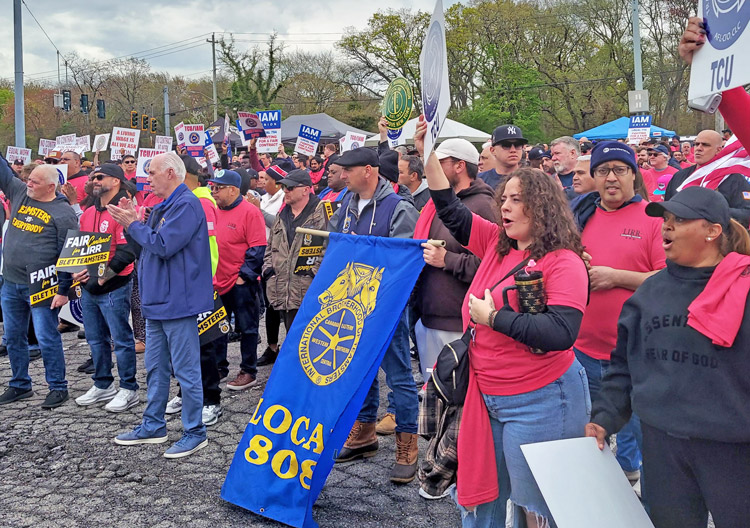
MASSAPEQUA, N.Y. — Some 500 rail workers and their supporters rallied here May 9, as a strike deadline one week away approaches, in a three-year-long fight with Long Island Rail Road bosses for a new contract with wages that keep up with rising prices.
The workers are members of five rail unions: the Brotherhood of Locomotive Engineers and Trainmen, Brotherhood of Railroad Signalmen, International Association of Machinists, International Brotherhood of Electrical Workers, and the Transportation Communications Union. These 3,500 workers comprise more than 50% of the LIRR workforce.
“All expenses are going up and our wages haven’t kept up with inflation,” Chris Macauley, a member of IBEW Local 589 who has worked at the Long Island Rail Road for 19 years, told the Militant. The unions had cost-of-living-adjustment clauses in their contracts in the 1980s, but the bosses took them away, he said. “Now we must fight for cost-of-living general wage increases.”
Under the anti-labor Railway Labor Act, these unionists have been tied up in red tape for three years, with mediation, cooling-off periods, Presidential Emergency Board recommendations and more preventing them from going on strike. But at this spirited rally workers made clear they’re united and ready to do whatever is needed.
“I am a homeowner with a 16-year-old daughter. How am I to do this with no raise now going on four years,” said Sandra Parker, a member of the Transportation Communications Union for more than 20 years. “Some people say you shouldn’t strike, but they should put themselves in our position. What else can you do but fight?”
The company and union officials had agreed to yearly retroactive pay raises back to when the contract ran out — of 3% starting in June 2023, 3% in 2024 and 3.5% the following year. But with this projected three-year contract ending a couple of months from now, the unions proposed a fourth year with a 5% wage raise.
The Metropolitan Transportation Authority, which owns and operates the Long Island Rail Road, countered with only 3%, which could rise by another 1.5% if the unions agree to give up longstanding work rules. “These work rules are to protect jobs and safety,” Rick Jordan, a retired engineer in the BLET for 22 years, told the Militant. This would mean speedup, pay cuts and contracting out union jobs. Even under the Railway Labor Act, two Presidential Emergency Boards, the last one reporting on March 16, backed the unions’ position on both wages and work rules. The LIRR rejected it out of hand.
In their drive for profits the LIRR bosses have been piling a greater workload on fewer workers, affecting work schedules and the ability of workers to spend time with their families.
The March 16 Presidential Emergency Board report notes, “BLET observes that when the LIRR completed its East Side Access project which allows it to go direct to Grand Central Terminal, train service increased by 40%, but the number of Engineers increased by only 16%. As a result of this short staffing, the Carrier has changed Engineers’ assignments, tours of duty are longer, and Engineers are moved around more.”
“Workers are often forced to work overtime because LIRR cut down on staff,” Gil Lang, BLET general chairman at the LIRR, said at the rally. “Then they use that overtime to say that we make too much money and don’t deserve a pay raise.”
The LIRR is the busiest commuter railroad in the nation. Its ridership in 2025 totaled more than 81 million. The last time the unions struck the railroad was 32 years ago.
“LIRR workers are tired of being told to sacrifice without getting anything in return,” Lang told the rally. “Without us the railroad doesn’t move. This region comes to a standstill.”
Seth Galinsky contributed to this article.