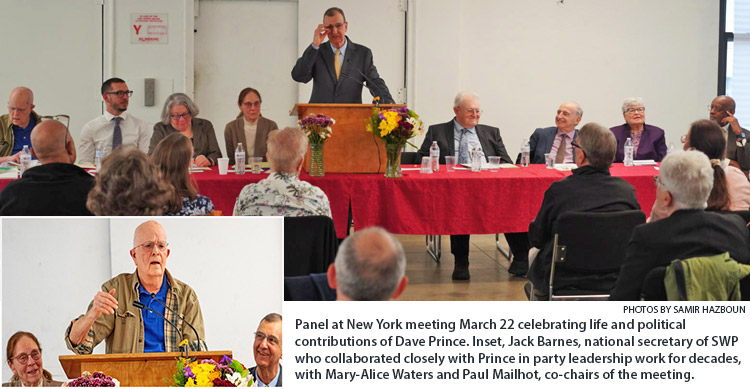
NEW YORK — “Above all, Dave Prince was a Marxist, a working-class revolutionist,” Jack Barnes, national secretary of the Socialist Workers Party, told participants at a March 22 event here celebrating Prince’s life and political contributions building a proletarian party in the United States. Sharing the platform were SWP leaders and co-chairs of the meeting, Mary-Alice Waters and Paul Mailhot, along with six other speakers.
The celebration, sponsored by the party’s Northern New Jersey and New York branches, was attended by 160 people.
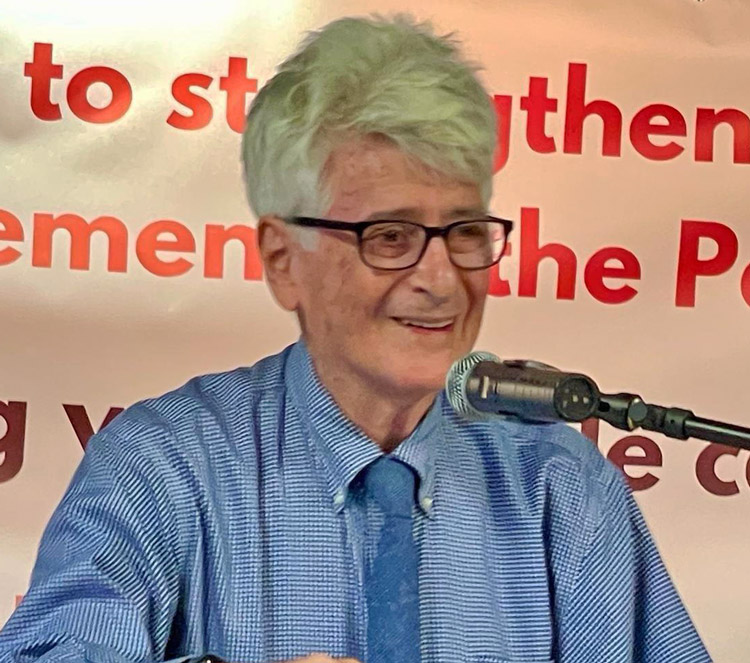
Prince, who joined the SWP in Cleveland in 1965, died on Jan. 25 at age 82, after a long battle against cancer. A member of the party’s National Committee since 1977, he shouldered a wide variety of central leadership responsibilities for the SWP’s party-building activity and international work. He helped organize and lead the financing of the party nationally, as well as the editorial preparation, printing, and circulation of books on working-class politics and program.
Over his more than 60 years in the party, he was a cadre and leader of eight party branches in six states, as well as a member of the United Auto Workers, International Union of Electronic Workers, and Machinists union. He was a worker-correspondent for this newsweekly, the Militant.
“In carrying out any leadership assignment he took on,” Barnes said, “no one was more conscientious. But Dave never fell back on the excuse of a ‘division of labor’ when he spotted a political opportunity not being acted on, or some other challenge that had to be addressed. I’d get a succinct memo about the stakes for the party. And some ideas on what to do about it.”
Most mornings, Barnes said, he’d find an email from Prince in his inbox. According to Vivian Sahner, Dave’s companion for decades, it wasn’t unusual for him to have sent off one or two notes before even brewing the morning coffee.
Those memos, Barnes said, frequently drew on Prince’s broad reading of the Marxist classics: works by Karl Marx, Frederick Engels, V.I. Lenin, Leon Trotsky, and Farrell Dobbs and other SWP leaders. The excerpts never came without a thought-out purpose. “It was pure politics with Dave,” Barnes said. “Pure practical politics.”
“Dave was always looking toward what was coming next in the class struggle.” More and more often today, Barnes added, what’s next are war moves and military threats by the U.S. imperialist rulers, Democrats and Republicans alike. That’s a product of the deepening capitalist crisis worldwide and sharpening competition among imperialist powers and other regimes of the exploiters, from Beijing and Moscow to Tehran. “It’s a product of their rivalry over the exploitation and control of sources of oil and other resources, profitable markets, and low-wage labor,” he said.
Barnes told the meeting that when he woke up Feb. 28 to news that Washington had launched a war on Iran, he knew right away that the SWP National Committee needed to issue a rapid statement demanding, “U.S. Out of the Middle East!” But for a minute or so, he said, he was still expecting a note from Dave in his email.
“‘There’s not going to be a note or a phone call this time,’ a comrade reminded me.”
“For Dave, the question was never just what’s coming next,” Barnes said. “It was what should we do next. He was a deadly enemy of procrastination.”
“Bolshevik leader V.I. Lenin’s What Is To Be Done? wasn’t only one of Dave’s favorite books. From its title to its content, that 1902 work was the guide to working together as members of a revolutionary centralist party — a party whose members, in Lenin’s words, are professional revolutionaries, regardless of what they do for a living. That was where Lenin explained the kind of party needed by revolutionary-minded workers, as well as the responsibilities of its members.
“Dave worked at being objective with every party member, supporter, or anyone else he worked with,” Barnes said. “There wasn’t a spiteful or gossipy bone in his body.”
A movement, not a doctrine
Prince was a voracious reader. “He had some favorites he’d often refer to in his notes,” Barnes said. One from the early years of Marx and Engels’ collaboration was an October 1847 article by Engels titled, “The Communists and Karl Heinzen.” It was written as the two young revolutionists were drafting a program for a new working-class organization, the Communist League, that they’d been recruited to by a group of veteran revolutionary workers from Germany, France, and elsewhere in Europe. “I shall never forget the deep impression that these three real men made upon me, who was then still only working to become a man,” Engels wrote some 40 years later.
A bourgeois radical named Karl Heinzen was publicly slandering the communists, saying they were trying to impose sectarian principles on the broader struggle for political freedom, instead of joining in that fight. Barnes said that Prince was unshakably committed to Engels’ reply: “Communism is not a doctrine but a movement, it proceeds not from principles but from facts. … [It is] the theoretical summation of the conditions for the liberation of the proletariat.”
Two months later, in December 1847, that line of march was formally adopted as the bedrock of the organization’s new program, what’s now known as the Communist Manifesto.
Prince also returned time and again to Lenin’s Imperialism, the Highest Stage of Capitalism, written in 1916 amid the first imperialist world slaughter. As Prince was quick to remind us, it remains a crucial guide for class-conscious workers in responding to what’s unfolding in today’s world — whether Washington’s assault on Venezuela, its brutal energy blockade of Cuba, or its war against Iran for oil and plunder of resources and labor in the Middle East.
Whether during World War I or today, as the ruling class marches us toward World War III, imperialism is not and never will be — in Lenin’s words — a “policy preferred by finance capital.” It is not a policy. It’s not something that can be “reformed” by some “progressive” wing of the capitalists, as class-collaborationist “socialists” of that time or today try to hoodwink working people into believing.
Despite what Lenin called “the silly little fable” about a more “peaceful” capitalism, its wars are a result of “the violent struggles among the imperialist states” to divide and redivide the world. Redivide — that’s where the wars come from, Barnes said. “That cycle can only be broken by the building of revolutionary working-class parties that can lead the successful conquest of workers power in one country after another. That is, by advances of the world socialist revolution.”
Over the past year, Barnes said, Prince had been centrally involved with other party leaders in preparing a new edition of In Defense of Marxism — a collection of articles and letters by Leon Trotsky from 1939-40, as he led a decisive political struggle in the SWP at the opening of imperialism’s Second World War. Trotsky deals with the question of how to build a Marxist leadership in the U.S., a revolutionary proletarian party — proletarian both in its program and in its class composition, activity, and organizational norms.
Trotsky explained why the SWP and communists the world over had to call for the unconditional defense of the Soviet Union against imperialist assault, at the same time leading an uncompromising political battle against the counterrevolutionary course of the world Stalinist movement.
“In many ways, In Defense of Marxism was the founding document of the Socialist Workers Party,” Barnes said. SWP branches across the country are now doing classes, studying it from cover to cover. Prince had been a stalwart in his northern New Jersey branch in getting those classes off the ground as a political example for the entire party.
Prince was a convinced materialist, too, Barnes said. “He knew we are all ‘star stuff,’” as a popular TV science program put it in the 1980s. “Dave considered Mary-Alice Waters, one of our chairs today, as his partner in defending science from assaults from anti-working-class forces on both the right and the ‘woke left,’” Barnes said. “Mary-Alice does a lot of writing about that for the communist movement, often as part of explaining and advancing the fight for women’s emancipation.”
Integrity and character
Many points highlighted by Barnes in his closing remarks to the meeting had been touched on by others on the platform based on their own experiences with Prince.
“Anyone who knew and worked with Dave recognized his integrity and character,” said Waters. “Whenever there was a special challenge or opportunity facing the party,” she said, “Dave was the first to call and say, ‘Need any help?’”
“He was a revolutionary with a great breadth of interests, in the arts, science, literature, and different industrial skills,” she said. “These interests enriched his life and sealed his confidence in the revolutionary capacity of the working class to rise to its historic responsibility to take political power and open the road to a socialist world of human solidarity.”
Waters read from a message sent by Prince’s sister, Judith Beyer, and his brother, Daniel Prince. From his earliest years, they wrote, his “love of art, and his creations were linked to his view of history and the world. Even in high school he was a voracious reader of revolutionary political classics.” David, they said, “was many things in life, and skillful at all: artist, tool and die maker, writer, organizer, and political leader.”
SWP leader Norton Sandler said that Prince looked at today’s world as part of history, knowing that “history is never static. The world is always changing.” Sandler said he had worked closely with Prince “when Dave was the party’s national financial director and when he led the party’s printshop and book distribution center on the West Side of New York City. Prince organized this work with the kind of proletarian professionalism that marked every aspect of activity undertaken by SWP leaders,” Sandler said. “He cared about the lives, health, and welfare of every cadre he worked with.”
With the advent of digital printing, Sandler explained, Prince was central in leading the transformation of both the production and distribution of books by communist and other revolutionary leaders. The aim was to make the best use of party cadres and financial resources, while maintaining the high political and printing standards Pathfinder Press was long known for. Among other things, that involved moving the international distribution center to a facility in Atlanta, whose day-to-day tasks are organized and carried out by an all-volunteer crew of party supporters.
War, Jew-hatred, revolution
A photo display illustrating Prince’s experiences and contributions to the party and working-class movement was a center of discussion during the reception and delicious hot meal prepared by party members and supporters in New York and New Jersey. After the speakers program, there was a dessert course.
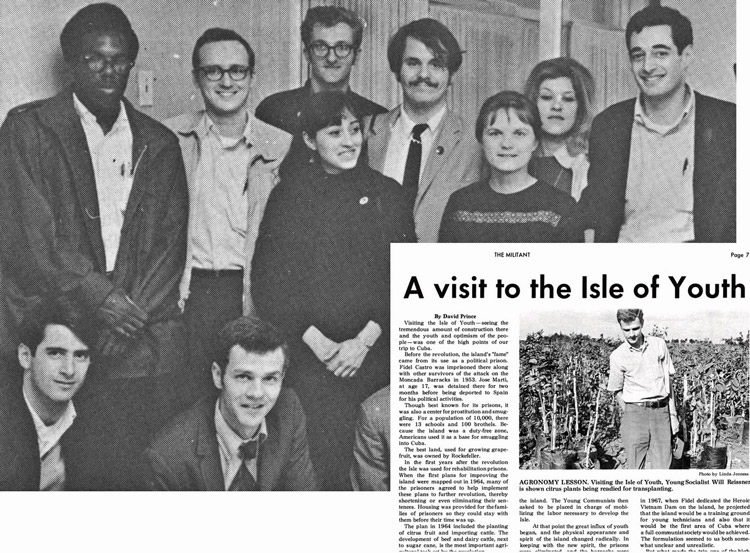
The multi-panel display stretched from Prince’s participation in a 1969 Young Socialist Alliance delegation to Cuba during the early years of the socialist revolution there, through his party activity over the past year. Among other things, it pointed to Prince’s political leadership of the SWP’s activity in the fight against Jew-hatred the world over and defense of Israel’s right to exist as a refuge for Jews.
That work has taken on special urgency since the Oct. 7, 2023, pogrom in Israel carried out by Hamas and other death squads, with full backing by the capitalist regime in Tehran.
Within months after that reactionary action to launch a war to destroy Israel and initiate a new Holocaust, the SWP was on the streets, doorsteps in workers’ neighborhoods and at political events campaigning with the book, The Fight Against Jew-Hatred and Pogroms in the Imperialist Epoch: Stakes for the International Working Class, edited and with an opening chapter by Prince. The book collects writings by communist leaders Lenin, Trotsky, James P. Cannon, Dobbs, and Barnes. Some 5,000 copies have already been sold.
In one of the more than 30 messages written for the tribute to Prince, SWP 2024 presidential candidate Rachele Fruit underlined how important his political guidance on that and many other questions had been for her. “Whether he knew it or not,” she wrote, “Dave marched at my side throughout the 2024 presidential campaign.”
In clear and unwavering terms, Fruit said, Prince explained that in the imperialist epoch, “Jew-hatred is a world question, not just a Middle East question.” And that Jew-hatred “is not eternal but is a class question,” a working-class question. It has a permanent place in how the U.S. and other imperialist ruling families in the U.S. and worldwide defend capitalism’s dog-eat-dog social relations in face of challenges to them by the working class and other exploited producers.
Fruit pointed to Prince’s explanation of why Trotsky’s 1938 message to Jews remains as accurate today as when it was written. “Now more than ever,” Trotsky said, “the fate of the Jewish people — not only their political but also their physical fate — is indissolubly linked with the emancipating struggle of the international proletariat.”
These points were reinforced in remarks by Lea Sherman, who worked together with Prince in recent years as members of the SWP branch in Union City, New Jersey. Not only did he help lead branch discussions on political questions of all kinds to guide the branch’s campaigning and activity in the mass movement, she said. In addition, in presentations at annual international conferences organized by the SWP, including a class in 2021 presented together with Sherman, Prince emphasized “the key place of the fight against Jew-hatred in building revolutionary parties capable of leading the working class and our allies to the conquest of political power.”
Leading international work
Presentations and messages to the celebration of Prince’s political life highlighted his collaboration with comrades in communist organizations in other countries.
Philippe Tessier, a leader of the Communist League in Canada, recalled that Prince, along with SWP trade union director Mary Martin, came to Montreal “to work with us during the November 2019 rail strike of 3,000 conductors at Canadian National Railway across the country.” Their collaboration, he said, helped the party “mobilize its entire membership to become part of that fight.”

“Whenever Dave came up for meetings,” Tessier said, “he always made a point of spending time with me and my workmates, as well as others interested in the communist movement. Always with an eye to recruitment. That sharing of experiences helped me and others of my generation keep acting on the more-than-century-long Marxist political continuity we’re part of.”
In a message on behalf of the Communist League in Australia, Linda Harris described the help Prince had given to efforts in that region of the Pacific in 2022 to fuse with communists in New Zealand into a single party based in Australia. Their goal was to take advantage of political openings in the Indo-Pacific region amid sharpening economic rivalries and the deepening conflict between Washington and Beijing. Along with Steve Penner from the Communist League in Canada, Prince was part of a couple of trips by leadership delegations that worked with comrades there to put the new fused organization on a strong footing.
Jonathan Silberman spoke at the New York event for the Communist League in the United Kingdom. The Socialist Workers Party leadership had helped in the League’s founding in 1988, Silberman said. Prince’s approach whenever he worked with us “was to bring Marxism’s living continuity to bear on party building,” Silberman said. The example he set in “the relation between program, party organization, disciplined functioning and human values was decisive.”
Lessons in working-class leadership
Among the political tasks Prince was involved in the last few months of his life were preparations for an SWP campaign to launch and promote Pathfinder’s most recent book: Cuba and the Independence War in Guinea-Bissau and Cape Verde: The Fall of the Last Colonial Empire in Africa, by Cuban revolutionary leader Víctor Dreke. The book describes the fight for freedom from Portuguese colonial rule led by Amílcar Cabral, whose leadership qualities — ones highly valued by Cuban leader Fidel Castro — are rich in lessons for struggles by workers and the oppressed the world over. The book also recounts the solidarity of Cuban volunteer combatants who joined their struggle.
Sam Manuel, a longtime member of the SWP’s Atlanta branch and its candidate for U.S. Senate in Georgia, spoke at the New York meeting about his recent work with Prince to get this work off the ground at the annual African Studies Association conference last November. Manuel organized the team staffing the Pathfinder Press booth there, and Prince shouldered national responsibility for participation in such conferences. By focusing special attention on the book — still forthcoming at the time — party members and supporters ended up selling nine advance copies, even though it wasn’t yet off the press!
From 1989 into the early 1990s, Manuel had been the party leader directing a large mural project depicting revolutionary leaders from around the world, many of whom were authors that Pathfinder Press put into print. The giant mural was painted on the side of the six-story Pathfinder Building, a few yards away from Manhattan’s West Side Highway and the Hudson River. Eighty artists from 20 countries volunteered to make the mural a reality. The portraits included one of Amílcar Cabral by New Zealand artist John Walsh and one by Manuel himself of the Congolese independence leader Patrice Lumumba.
“Dave took a keen interest in the mural,” Manuel said. And to reach out as widely as possible with the new book by Dreke. Prince and Manuel had discussed drafting a feature article for the Militant about the Pathfinder Mural and Cabral portrait, an article in the works for a coming issue. It will promote the full-color poster of the mural available on Pathfinder’s website as well.
Also speaking on the platform was Holly Harkness, coordinator of Pathfinder’s Atlanta distribution center. “I was involved when the SWP launched an auxiliary organization of party supporters in 1998 to help it produce and promote books and other needed material,” she said, “as well as to help finance expansion of the party’s work.” Prince was key to helping supporters “establish and maintain the norms and standards for that work,” she said. “He put those standards in the political perspective that made our work so important.”
In a written message, Atlanta SWP branch organizer Susan LaMont pointed to a valuable by-product of Prince’s frequent trips to work with the Atlanta Distribution Center. “He often volunteered to speak at the Militant Labor Forum” when he was in town. And, as with other branches, “Dave worked with us to clarify many political and party-building questions, too,” LaMont said.
“We considered ourselves a pretty lucky branch.”
‘The apple of his eye’
In closing his remarks, Barnes briefly described a visit with Dave and Vivian at the hospital where he was receiving care.
As to be expected, Barnes said, before anything else Dave wanted to talk about a passage in Lenin’s Imperialism that he correctly thought shed light on the U.S. government’s military buildup in the Middle East. That was several weeks before Washington launched its all-out air war against Iran.
“We discussed the importance of Israel’s fight to stop the rulers in Iran from acquiring nuclear weapons and expanding their arsenal of ballistic missiles and drones. And the party’s unconditional demand, ‘U.S. imperialism out of the Middle East!’”
Prince was also following with great interest the strikes by some 15,000 nurses for three large hospital corporations in New York City.
And, of course, Barnes said, Prince wanted to know how the work and campaigns of the party and world movement were doing.
“Dave was a peculiar patient in many ways,” Barnes said. The doctors and nurses had never met people like Dave and Vivian. “The two of them had organized Dave’s room to make space for a small but growing library. And space for Dave’s pastels and other drawing tools. Less unusual, they set up the TV in the room to watch college football. Vivian is a dedicated University of Alabama fan. Roll Tide! Viva Vivian!”
Prince was interested in the exhibition of art by Cuban artist Wifredo Lam being shown at the Museum of Modern Art at that time. “It was related to some work he was doing,” Barnes said, “so we got him a copy of the catalog. That went alongside writings on art and literature by Marx and Engels, by Lenin, by Trotsky.”
Barnes finished by recalling the introduction Prince wrote in 2020 for a new edition of The Jewish Question: A Marxist Interpretation by Abram Leon — an account of the emergence and transformation of Jew-hatred from ancient times to the triumph of Nazism in Germany. The author was a young leader of the Revolutionary Communist Party in Belgium who was captured by the Gestapo in 1944 and killed in the gas chambers of Auschwitz.
Ever since Leon’s book was first published in French in 1946, and then in English in 1950 by Pathfinder’s predecessor, it has contained a “biographical sketch” of the author by Ernest Mandel. Mandel was the one surviving RCP leader who had known and worked closely with Leon in the 1940s. For that reason, Barnes said, “Pathfinder decided to keep that piece as an appendix to the new edition.”
Barnes said he was raising this because he had been struck by the contrast between the values and character traits Ernest Mandel held up as a model for revolutionaries, and those recognized and admired by anyone who knew and worked with Dave Prince.
In the closing paragraphs of the biographical sketch, Mandel wrote that many readers might ask why Leon and others like him — “among the most gifted European intellectuals,” in Mandel’s words — would “choose a movement that could promise them neither success nor glory nor honors nor even a minimum of material comfort, but which on the contrary demanded of them every sacrifice, including their lives, and which required long thankless work, frequently in isolation from the proletariat to whom they wanted to give everything?”
“That’s the opposite of how Dave ever saw himself,” Barnes said.
“For Dave, the party gave him and his comrades the most magnificent opportunity imaginable to be revolutionaries fighting for the interests of the international working class. The Socialist Workers Party was the apple of his eye, the living instrument that connected him with that revolutionary continuity, that Marxist course past, present and future.
“Far from being ‘thankless work,’” Barnes said, “Dave saw it as crucial to building the proletarian party that workers in their tens and hundreds of millions need to wage the revolutionary struggle for political power and a socialist world.”
The program concluded with an appeal Dave Prince would have considered essential to any such event: Contribute as generously as possible to the ongoing work of the SWP. More than $23,000 was collected.