GREELEY, Colo. — “JBS makes billions off our broken bodies. To them we are not worth as much as the beef going down the line,” John Trimble told the Militant. The 69-year-old Trimble says he has worked at the plant for decades. He explained why 3,800 meat processing workers, members of United Food and Commercial Workers Local 7, went on strike March 16 — to defend their lives and livelihoods against the abuses and exploitation of the packinghouse bosses at JBS here.
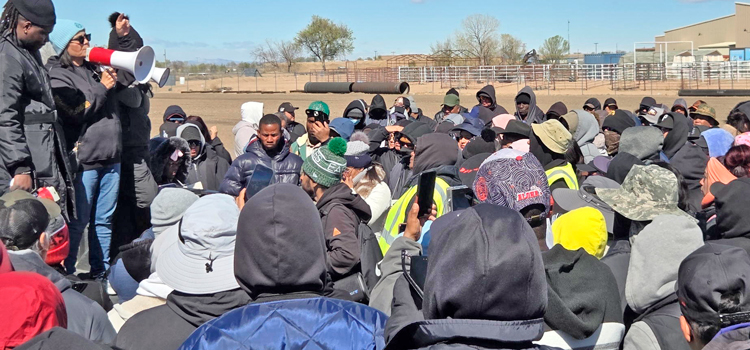
Despite strong wind gusts and deep cold, members of Local 7 showed their willingness to continue the fight into a fourth week at an April 3 open air union information meeting in a field across from the plant.
Workers cheered when Local President Kim Cordova announced the company had asked to return to negotiations April 9-10. And they cheered again when she announced that the company had agreed to reimburse workers for wrongful payments they were forced to make to get mandatory protective equipment, including mesh metal aprons and gloves, that they’re required to wear in order to do their jobs. Her talk was translated from English into four other main languages spoken by workers in the plant — Spanish, Haitian Creole, Burmese and Somali.
Workers booed when Cordova announced that the company, in a move to disrupt the union’s picketing, had rented from the city beginning the following week the empty lot where the meeting was taking place and where regular strike update meetings are held, as well as renting the adjacent parking lot where thousands of union members park before picket duty in front of and on the side of the plant. Cordova said the union had so far found no alternate space for meeting and parking.
Taking the fight back into the plant
The union had organized to give out strike pay and take the picket lines down for the Easter holiday weekend. Then on Saturday, April 4, union officials notified workers that because they were restarting negotiations and with a few concessions made by the bosses, the union had agreed workers would return to work on April 7. In a union statement Cordova said, “Workers remain united and will continue to fight.”
The Local 7 picket lines involved hundreds to 1,000 workers per shift, twice a day. They marched from the parking lot to the picket line and lined up on the street for a mile across and alongside the plant. The striking workers came from every continent on earth and speak 57 languages. Workers took breaks on the ground near the line, sitting on blankets, preparing food, playing music from their home countries and, above all, having nonstop discussions with any visitor to their strike about what they were up against.
Mariano Gallegos, 73, said he has 41 years in the plant and his job today is making boxes for packing the beef product. He said a major issue, one that reflects the bosses’ contempt for them, is that the company tries to bully and harass people who ask to go to the bathroom. “It happens sometimes that people soil themselves.”
Many workers spoke to the Militant on condition of anonymity, for fear of retaliation by the company for their fight for dignity and safety, and the unity they advanced in this fight.
Many discussed the abusive treatment handed out by supervisors in the plant. They pointed to incidents of physical abuse, including a boss striking a woman worker in the face; a boss wiping the fork lift tire tracks off the boots of a worker whose foot the boss ran over and forging a worker’s signature on a disciplinary write-up she refused to sign.
Almost every worker talked about the ever-increasing line speed, which causes more injuries and accidents as workers struggle to keep up. The union Facebook page shows pictures of workers’ hands with missing and twisted fingers, gouges and scars.
“The line is so fast we can’t even pause to take a sip of water,” Olivier Mulanau, said. His job is gutting the cattle carcasses as they roll by him.
On top of all this was the insulting $1.20 an hour wage “raise” offer over three years, something that won’t keep up with inflation.
Workers more confident and united
“This fight was a long time coming. It has been boiling for years and finally boiled over,” Ramón Zuñiga, secretary-treasurer of Local 7, told the Militant. “It is very inspiring to me and others to be in the middle of this fight with workers from all over the world asking for better wages and conditions.”
Ramiro Alvarez said he has worked at the plant for 35 years and done most every production job in there. His current job is sharpening knives. While he is proud of the fight they are waging, he lamented the fact that some workers were crossing the line and going to work because of the economic pressure they’re under. He said one of his good friends is working inside during the strike.
Alvarez added that he respects the Somali workers for standing up for themselves, sticking together and insisting on their right to have prayer breaks in the plant as part of practicing their religion. This was a gain won in hard-fought battles at packing plants in Colorado.
This strike came as U.S. cattle production hit a 75-year low, The Associated Press reported. The decline was driven by drought and low prices packing bosses offered to ranchers. The market for cattle is monopoly-controlled by the big four beef packers — JBS, Tyson, Cargill and National Beef Packing Company. Together they control well over 70% of cattle slaughtered.
At the same time, beef product prices in the supermarkets have soared. The Greeley JBS plant produces 6% of all beef produced in the U.S.
Beef producers like JBS and Tyson are driving to increase profits and cut costs, regardless of the toll on the human beings who work there. The Nebraska Examiner reported on the unexpected closing of the Tyson plant in Lexington, Nebraska in January, which had employed some 3,200 people. It had a devastating impact on the workers and all those in the town of 11,500 people.
Tyson claimed it stood to lose some $600 million in its beef business over the 2026 fiscal year, on top of a $720 million loss over the last two years.
Like at JBS, many of the workers were immigrants. “I worked at the plant for 32 years,” Alfredo Flores, a former Tyson plant employee and long-time Lexington resident, told Nebraska TV. “Now it’s really tough out here.” He said Lexington is like a ghost town now, with people moving away to look for work.
At JBS, the fight continues with workers back inside the plant determined to stand up for themselves. Many told the Militant how much stronger they felt for coming together in the strike.