
The 40th anniversary of the world’s worst nuclear disaster, the 1986 explosion and fire destroying reactor No. 4 of the nuclear power plant in Chernobyl, Ukraine, is April 26. But Moscow’s over-four-year-long war attempting to seize that sovereign country risks a new catastrophe there.
In 2019 a protective dome was erected by an international capitalist consortium, supposedly to safely confine Chernobyl’s dangerously radioactive ruins for a century. But a Russian drone strike in February last year punched a large hole in the dome.
The giant steel shell was built to contain the crumbling concrete tomb, the so-called sarcophagus that was hastily erected in 1986 around the radioactive ruins of the meltdown. Moscow’s missile strike last year caused a fire that spread inside the radioactive interior. It took Ukrainian firefighters over two weeks to extinguish the blaze. They had to drill 300 additional holes to put it out.
Ukrainian emergency workers have covered the main hole with a protective metal sheet, little more than a glorified tarpaulin. The challenge of reestablishing a stable containment structure, decommissioning the three remaining reactors, and removing radioactive waste in the ruins of reactor No. 4 has been compromised by the damaging attack.
Radioactive danger remains
“If the [concrete] shelter collapses, a radioactive cloud will rise,” Serhii Tarakanov, the Chernobyl plant’s general director, told the March 26 Financial Times. “As 1986 taught us, radiation does not recognize borders. The wind will carry these [radioactive] transuranic elements across Europe” again.
“This isn’t a ‘Ukrainian problem,’” he added, “it is a continental threat that is being ignored.”
The catastrophic 1986 nuclear meltdown and resulting radioactive fire in the Chernobyl reactor was exacerbated by the Stalinist rulers in Moscow and their criminal failure to enclose it with a containment vessel, which could have trapped most radiation. Soviet authorities attempted to cover up the unfolding disaster until radioactive clouds were detected spreading over parts of Europe.
The Chernobyl catastrophe also revealed the Stalinist bureaucracy’s contempt for working people. The Soviet government was callously indifferent as thousands of the plant’s workers and firefighters, with little or no protection, selflessly fought to contain the fire.
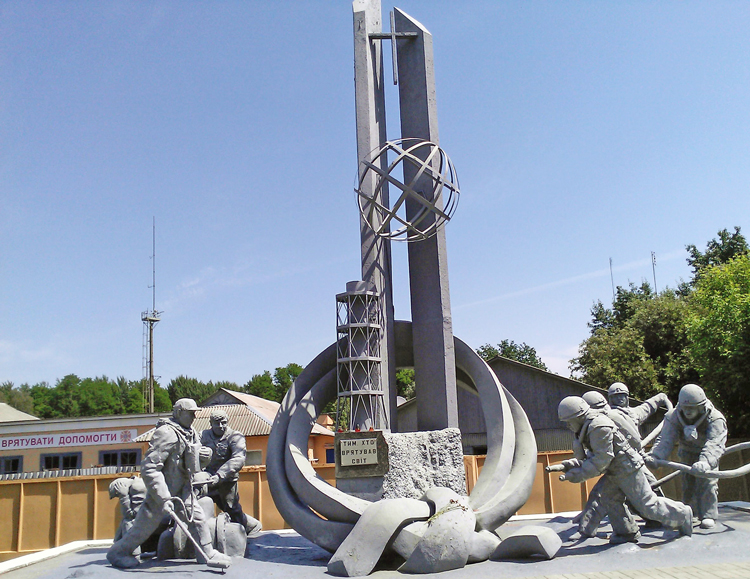
The fire department at Chernobyl perished from exposure to radioactivity after fighting the fire. Tens of thousands of other Ukrainian workers, mostly volunteers known as “liquidators,” came to try to bury the radioactive remnants. Thousands have died and many more suffered from radiation poisoning.
Millions of residents of Ukraine, Belarus and Russia received severe doses of radiation and many sickened or died.
The catastrophe accelerated the coming apart of the Soviet Union, which disintegrated in 1991 as Ukraine and other Soviet republics declared independence.
Cuba’s internationalist response
In stark contrast to the way the Stalinist bureaucracy acted, Cuba’s revolutionary government responded to the disaster by sending doctors to set up clinics in affected areas of Ukraine, Belarus and Russia. Then Cuba offered to establish a special facility at Tarara near Havana to provide intense medical and other care to the sickest, youngest victims of Chernobyl, mainly from Ukraine. More than 25,000 were treated there at no charge.
This was a powerful display of proletarian internationalism by Cuba’s socialist revolution. The program only ended in 2011 when the then Moscow-backed Ukrainian government stopped flying patients to Cuba.
In 2014 a Militant reporting team led by current editor John Studer visited the Chernobyl exclusion zone at the invitation of the workers’ union there. They described the heroic efforts by Ukrainian workers to prevent an even greater disaster, as well as the devastating, long-term social, medical and environmental consequences. They explained the support for Ukrainian independence held by the hundreds of Chernobyl workers they met, who manage the site today.
As part of their invasion in February 2022, Moscow’s forces briefly occupied the nuclear plant, holding its staff hostage. Russian troops dug trenches and camped out in the highly contaminated “Red Forest” surrounding the facility, with deadly consequences for many.
That year invading Russian forces also took control of the Zaporizhzhia nuclear power plant, Europe’s largest, in southeastern Ukraine. Studer and the Militant’s reporting team had also visited that site in 2014, meeting with leaders of the union. Today, the Russian occupiers use the inoperative plant as a military base, keeping a skeleton crew of Ukrainian workers to prevent the reactors from overheating and exploding. They have been subject to physical abuse and worse.