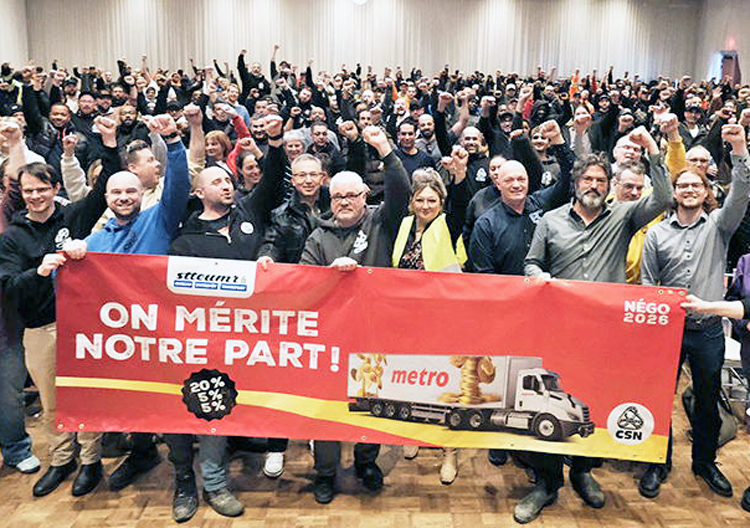
MONTREAL — “We’re determined to fight to win a living wage, safe working conditions and livable work schedules,” Mathieu Gagnon, secretary of the United Grocers Workers Union and picket captain since the workers went on strike March 30, told the Militant. The union is part of the Confederation of National Trade Unions (CSN).
The union represents 550 workers at the Laval fruit and vegetable warehouse at the company’s main office in Montreal, and drivers at the warehouse in Rivieres-des-Prairies.
Under their last six-year contract, which expired in September, workers only received an 11% wage increase — less than 2% a year, well below the rate of inflation.
Workers are now demanding a wage increase of 20% in the first year of a three-year contract, to make up for lost ground, and 5% in each of the last two years. The company has refused, offering the highest-paid workers 11% over six years and the lowest paid workers a measly 1% a year. That’s not an increase; it’s a wage cut!
Over the same six years, Metro’s profits “increased by 39%,” said Serge Monette, president of the CSN’s commerce division. “Dividends to shareholders rose by 56%, while the group’s president and CEO, Eric La Fleche, got a 37% pay raise.”
Metro Inc. is one of the two largest supermarket chains in Quebec, with 670 stores, and one of three largest chains across Canada.
At a mass meeting April 2, workers voted unanimously to reject the bosses’ proposal. They had voted to go on strike by 97% earlier.
Metro obtained a court injunction barring workers from picketing within 5 meters (15 feet) of facility entrances. That means they can’t stop production — the goal of the strike.
Striking workers told the Militant that safety in the warehouse is a key issue. The job involves regularly lifting boxes weighing 30 kilograms (66 pounds) or more over their heads. The result is a lot of lower back and shoulder injuries.
In January 1993, Metro announced that it was shutting down its food distribution service, outsourcing 135 drivers’ jobs to three outside companies and laying off 15 workers in its printing plant. The workers there waged a six-year battle, eventually winning back their jobs along with a 33 million Canadian dollar court settlement ($23.6 million).
It turned out Metro had secretly set up a separate nonunion company, “M. R. Merchants’ Association,” to take the truckers’ jobs, saving CA$3.5 million a year.
Even though the union won the fight, the company continues to contract out union drivers’ jobs, going from 150 in 2010 to 40 or so today. And the drivers are forced to work mainly at night and on the weekend, rarely on weekdays.
Addressing this inhumane work schedule is one of the issues in the strike. “We’re fighting for workers to be able to have a better family life,” Gagnon said. “We can’t accept these attacks. We have to fight back.”
Solidarity is crucial. The workers are picketing at the warehouses in Laval and Riviere-des-Prairies 24-7, and at the head office in Montreal during business hours. Join them!