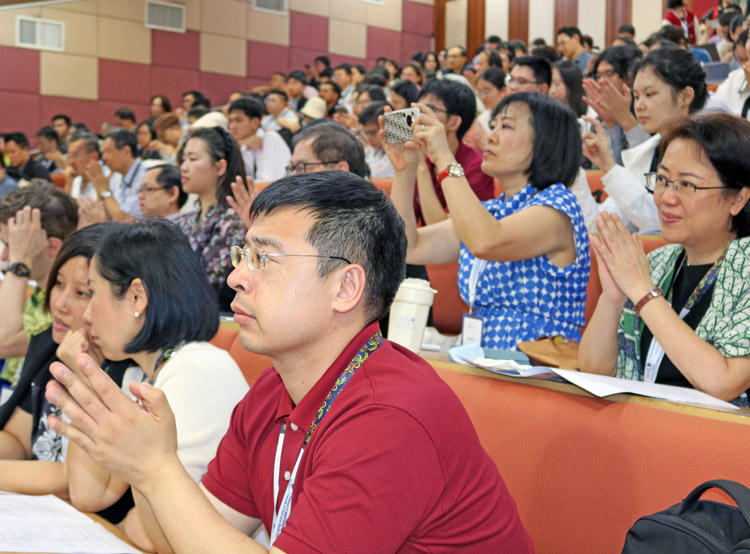
KUALA LUMPUR, Malaysia — “Chinese Overseas in a Changing World: Global Networks, Local Realities” was the theme of the 12th International Conference of ISSCO, the International Society for the Study of Chinese Overseas, that took place Nov. 4-6 at the Malaya University of Malaysia. Out of a population of 34.1 million, more than 22% of Malaysians today are of Chinese ancestry. This was the second ISSCO International Conference to be held here.
Since its founding in 1992 ISSCO has organized conferences, from Southeast Asia to North America, South Africa, Europe, the Caribbean and beyond. The gatherings have served to promote knowledge of the rich history of Chinese living overseas in countries around the globe, including their struggles against prejudice and discrimination.
Some 500 people from 27 countries participated in the Kuala Lumpur conference, ISSCO’s largest ever, and 96 student volunteers from Malaya University worked to ensure the conference’s success.
The sharpening conflicts between Washington and Beijing and their impact on some 40 million Chinese living and working overseas was at the center of both the plenary sessions and during more than 80 panel discussions at the conference — approximately half of which were conducted in Chinese with the other half in English.
“Our changing world faces numerous uncertainties,” outgoing ISSCO President Li Minghuan, a professor at Xiamen University in Fujian Province in southern China, told the conference’s opening session. “China’s rising stature, China-U.S. relations, China-EU relations, and China’s relations with the Global South shape not only the general trend of the world. They also have an impact on the development of overseas Chinese communities.”
Washington emerged as the world’s dominant imperialist power following its blood-soaked victory in World War II. Today, it seeks to shore up its weakening place at the head of the capitalist world “order” and push back the growing economic and military strength of Beijing.
Chinese rulers challenge Washington
The Chinese rulers have extended their industrial power across Asia, Africa and Latin America and are deploying greater military clout, especially in the Pacific. This includes Beijing’s long-standing determination to take control over Taiwan, which it considers an integral part of the People’s Republic of China. The U.S. rulers, who are equally determined to maintain their dominant power in the Pacific, are reinforcing their military alliances with the rulers of Japan, Australia, the Philippines and others in the region.
In one of the keynote addresses during the conference, Tan Chee Beng, adjunct professor at University Tunku Abdul Rahman in Malaysia and a former president of ISSCO, spoke to this reality: “An economically and militarily powerful China may not make life of the Chinese overseas easier, especially in the current situation of China-U.S. rivalry which also involves U.S. allies. Chinese overseas need to be sensitive to local reality, while at the same time they need to defend their ethnic and cultural rights.”
A highlight of the conference was a forum organized around this theme in a plenary session panel featuring academics from the People’s Republic of China, the Philippines, South Africa, Singapore and Malaysia. In “the current geopolitical reality … overseas Chinese are under increasing scrutiny in countries where they now live,” moderator Zhou Min from the University of California said in her opening remarks.
ISSCO conferences in each of the last three years all featured sessions where participants discussed the harassment and prosecution of scientists, academics and businessmen of Chinese origin, and successful campaigns to defend them against charges of espionage in the service of Beijing.
Fight for Malaysia’s independence
Another of the themes addressed in panels and other activities during the conference was the rich history of Malaysia.
Following the Japanese attack on the U.S. Navy base at Pearl Harbor, Hawaii, which marked the beginning of World War II in the Pacific in December 1941, Japanese forces invaded Malaysia, then a part of the global British Empire. Within a few weeks the British colonial masters of what was then called Malaya were expelled as the Japanese army swept south. When the tide of war turned, and Japanese troops were defeated in 1945, however, that did not usher in Malayan independence. Instead, a new period of British domination and years of civil war opened.
The imperialist forces eventually crushed the armed insurgency, which had a strong base among the Chinese plantation workers, but were forced to concede independence in 1957. Their legacy of divide and rule — pitting the indigenous Malay population against Chinese and Indian communities that at the time constituted roughly 50% of the total population of Malaya — has deeply marked Malaysian government policies ever since.
Reflecting interest in the sharpening international class struggle, many conference participants stopped to discuss with volunteers from Australia, Canada and the U.S. at a table of Pathfinder books, featuring titles on revolutionary struggles led by working people around the world.
Our History Is Still Being Written: The Story of Three Chinese Cuban Generals in the Cuban Revolution was the most popular title. It describes the little-known history of Chinese workers in Cuba’s struggles against Spanish and U.S. domination and their participation in the country’s socialist revolution that brought an end to the decades of discrimination Chinese Cubans faced.
At the closing session, the conference’s organizing chairman and new ISSCO president, professor Datuk Dr. Danny Wong Tze Ken, announced that Wenzhou University in China will host the next regional ISSCO conference in 2026. The university has a large department on the study of Chinese overseas and a program designed to encourage overseas Chinese students to come study in China.