In a sharp escalation of threats against the government of Venezuelan President Nicolás Maduro, U.S. military forces seized a large oil tanker carrying crude from Venezuela Dec. 10. It’s the latest violation of the country’s sovereignty as part of the U.S. rulers’ drive to overthrow the government in Caracas and impose one subservient to their interests.
A day earlier, two U.S. Navy F/A-18 Super Hornets flew right into the center of the Gulf of Venezuela near Maracaibo, the country’s second-largest city and main oil-producing region. This is the closest U.S. fighter jets have flown toward the coast of Venezuela since September, when the Pentagon began its provocations by sending an armada to the Caribbean and expanding its deployment of military forces to countries in the region.
Washington has conducted a wave of strikes against boats off Venezuela’s coast, which the White House claims were trafficking drugs to the United States from Venezuela. According to the U.S. Southern Command, 25 boats have been destroyed at sea with some 95 people killed.
The oil tanker, called the Skipper, was loaded with 1.1 million barrels of heavy crude when it was ambushed by U.S. forces in international waters between Grenada and Trinidad and Tobago. Before that, Skipper offloaded some 50,000 barrels to another ship for delivery to Cuba. The rest of the crude — contracted by a Cuban state-run oil trading firm and a Panama-based broker — was to be sold to China.
U.S. forces took the captured vessel to Houston. When asked what will happen to the oil, valued at tens of millions of dollars, President Donald Trump said, “We keep it, I guess.”
The White House says the ship was sanctioned by the Treasury Department in 2022 over accusations that it was part of a network of shadow tankers smuggling crude on behalf of Iran’s Islamic Revolutionary Guard Corps and Hezbollah in Lebanon. U.S. officials say the ship was also used to transport sanctioned Venezuelan oil.
Maduro said the assault revealed the real reason for Washington’s aggression against Venezuela. “It has always been about our natural wealth, our oil, our energy, the resources that belong exclusively to the Venezuelan people,” he said, not drug trafficking. “The U.S. Coast Guard and military are being given orders to commit illegal acts of piracy,” he added. “They have already been ordered to kill and finish off boatmen” who “were not even going to the United States.”
On Dec. 16 Trump announced that U.S. forces will impose a blockade on “all sanctioned oil tankers” entering or leaving Venezuela. This would ratchet up the pressure on Venezuela’s economy, which relies on oil exports for much needed revenue to import basic necessities like food and medicine.
Cuba condemns assault on Venezuela
“This act of piracy and maritime terrorism is a serious violation of international law,” Cuba’s Foreign Ministry said Dec. 12. It is “aimed at hampering Venezuela’s legitimate right to freely use and trade its natural resources with other nations, including the supplies of hydrocarbons to Cuba.”
Since 2000, Venezuela’s government, first under Hugo Chávez and then Maduro, has sent oil to Cuba at highly subsidized prices, allowing Cuba to ease acute shortages, especially after the collapse of the Soviet Union — its main trading partner — in the early 1990s. The growing ties between Venezuela and Cuba earned the wrath of Washington, which hoped to bring down the socialist revolution by tightening its economic war against Cuba and isolating the country.
In 2019 the U.S. government stepped up measures to block fuel supplies to Cuba by blacklisting vessels. This has contributed to Cuba experiencing some of the worst power outages in decades, with blackouts stretching for hours, sometimes days. Cuba’s electrical system has stayed afloat largely because of oil received from Venezuela, Russia and Mexico.
“Hopefully the end of Mr. Maduro’s reign of terror in Venezuela is near, and then we can focus on Cuba, one of his greatest allies and one of the most oppressive regimes in our backyard,” wrote Republican Sen. Lindsey Graham. His comments express the bipartisan intent of the U.S. imperialist rulers.
The Cuba-Venezuela oil program is part of a broader political and economic collaboration between the two countries. Cuba sent internationalist volunteers to Venezuela to help implement social reforms initiated by the Chávez government in the early 2000s. They helped make medical care more accessible to millions of Venezuelans, and to eliminate illiteracy.
The contribution of Cuba’s internationalist volunteers was nothing new. It’s consistent with the revolutionary government’s long record of support for national liberation struggles as well as sending medical brigades to care for victims of natural disasters.
Washington slanders Cuba’s international medical programs as “human trafficking,” and vilifies Cuban doctors as being agents of its government.
Officials in Washington are currently peddling the lie that Cuban agents control Venezuela’s intelligence and military apparatus, as well as the presidential security detail. In fact, they say, Maduro fears being killed by his own Cuban allies if he decides to relinquish power.
In early December, Reuters reported that Cuban officials had reached out to Washington “about what the region would look like without President Nicolás Maduro” in office. Josefina Vidal, Cuban deputy foreign minister, rejected the report as blatant lies “to implicate Cuba in the fabrication of falsehoods and pretexts to justify” the aggression.
The Cuban government has consistently spoken out against Washington’s effort to topple Maduro.
Working people in the U.S., Latin America and the Caribbean are following the Trump administration’s provocations against Venezuela. Many question the extrajudicial killings at sea and are not convinced there is any “evidence” to justify bombing boats allegedly carrying drugs, nor by Washington’s claims that Venezuela poses a threat to the U.S.
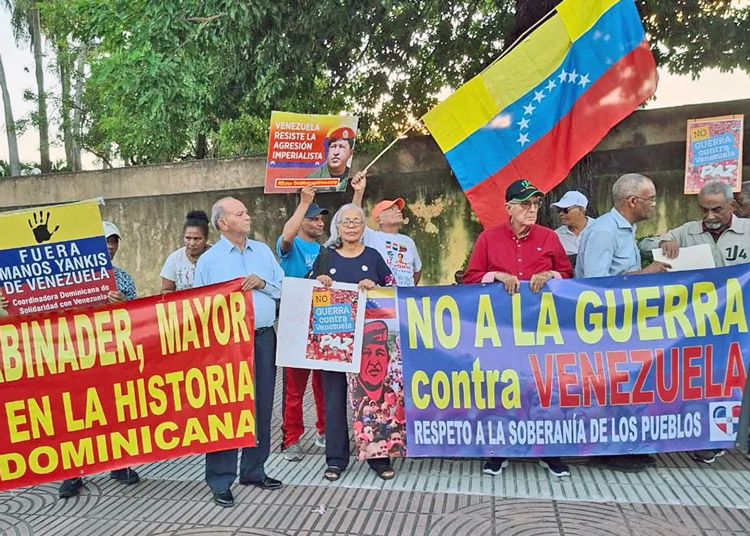
In the Dominican Republic, President Luis Abinader has permitted U.S. military planes to use the country’s San Isidro Air Base and main international airport in operations in the Caribbean. A protest in Santo Domingo Dec. 10 strongly rejected the use of the facilities as a base to attack other nations, with some participants recalling Washington’s invasion of the Dominican Republic in 1965.