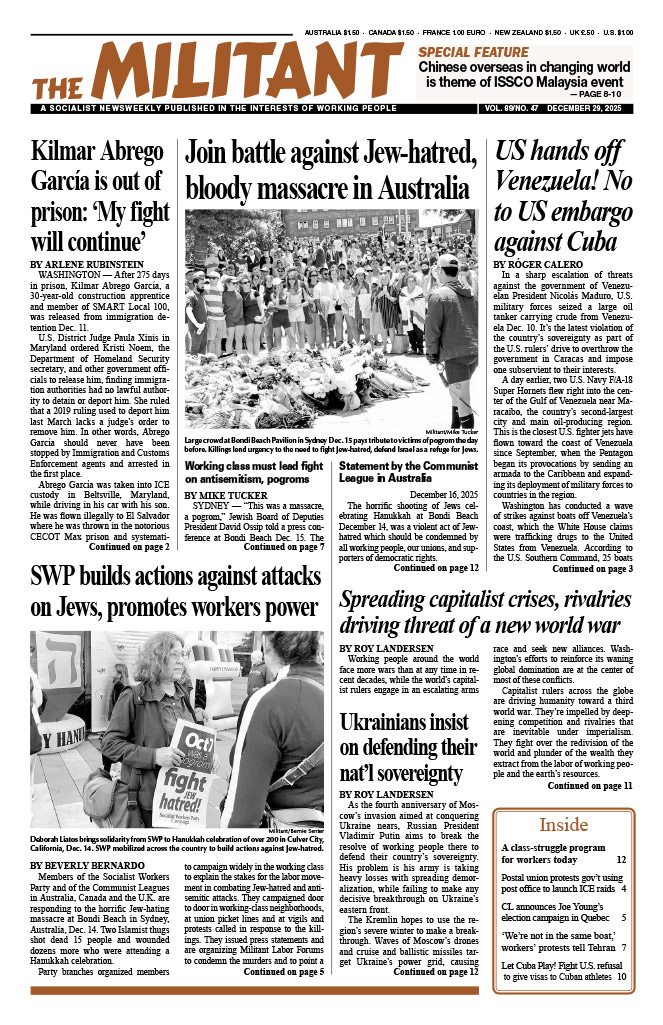
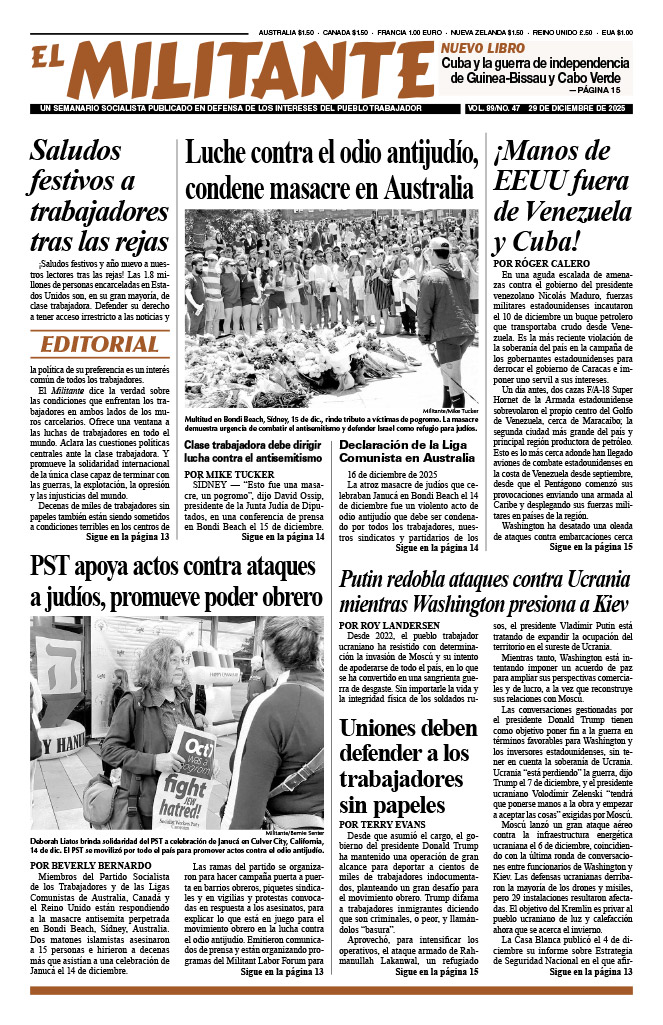
As the fourth anniversary of Moscow’s invasion aimed at conquering Ukraine nears, Russian President Vladimir Putin aims to break the resolve of working people there to defend their country’s sovereignty. His problem is his army is taking heavy losses with spreading demoralization, while failing to make any decisive breakthrough on Ukraine’s eastern front.
The Kremlin hopes to use the region’s severe winter to make a breakthrough. Waves of Moscow’s drones and cruise and ballistic missiles target Ukraine’s power grid, causing lengthy cuts to power, heat and light across most of the country. At the same time the drones are used to target civilians.
After a sustained aerial attack by Russian missiles, tens of thousands of people in the southern port city of Odesa were without electricity for three days in mid-December.
“Life has been difficult, but people are very supportive of each other,” Yana told the BBC, reflecting the determination Ukrainians have to keep fighting. She still has power and invites people to her home to charge their phones. She says she and others who have power or generators offer anyone who needs it the chance to wash or take a shower.
Near the Donbas front lines, DTEK, the largest power company in Ukraine, providing power for 5.6 million Ukrainians, has been attacked every three or four days.
Eight of DTEK’s engineers have been killed on the job. “Every day they risk their lives to keep power in the area,” Maxim Timchenko, the head of DTEK, said.
Washington presses for peace deal
Officials in the Donald Trump administration are pressing Ukraine to agree to a ceasefire deal in order to clear the way to advance U.S. imperialist interests in the region, with no regard for Ukraine’s sovereignty. Trump has offered Moscow normalized economic and political relations in exchange for halting a war it shows no signs of ending.
Trump’s negotiators have reached a side deal with the government of Belarus, a close ally of Moscow. President Alexander Lukashenko agreed to release 123 political prisoners Dec. 13 in return for the Trump administration lifting sanctions on Belarusian potash exports.
Those released include Ales Bialiatski, who fought for rights for political prisoners; Maria Kalesnikava, who helped lead mass protests against Lukashenko’s rule in 2020; and Viktar Babaryka, imprisoned when he ran against Lukashenko in the 2020 election.
Washington hopes to pull Lukashenko away from Putin. “There’s no such thing as permanent allies or permanent enemies,” a U.S. official involved in talks with Kyiv and Moscow told the Financial Times.
Putin says there will be no deal unless Ukraine cedes the whole of Donbas, a key mining and industrial region. But his troops only occupy about 80% of the area.
Washington had demanded Ukraine give up the territory, but Ukrainian President Vlodymyr Zelensky flatly rejected this reflecting the views of the majority of Ukrainians. On Dec. 11 he rejected a new U.S. proposal that Ukraine withdraw from Donbas and designate it as a “demilitarized zone,” with no guarantee Moscow’s forces wouldn’t march right in.
Cities in the western Donbas are key to Ukraine’s efforts to repel Moscow’s advances. Nearly three-quarters of Ukrainians would accept a freezing of the front lines, a survey released by the Kyiv International Institute of Sociology showed Dec. 15. Almost two-thirds are willing to keep fighting.
Kyiv’s forces have retaken parts of Kupiansk, a key Ukrainian town in the Kharkiv region, which Moscow claimed control of Nov. 21.
The small gains Moscow has made on the eastern front come at a devastating toll to the lives and limbs of its troops. Working people in Russia’s army and who live under Putin’s tyranny are the most important potential allies in Ukraine’s fight.
Bruce Keller is a former U.S. Marine who volunteered for Ukraine’s Foreign Legion. He looks to win respect and collaboration from Russian soldiers he captures. He shows them respect, in sharp contrast to the brutality and torture Russian commanders mete out to Ukrainian prisoners of war.
“On your knees, please,” he says in a video showing the capture of Russian troops, before offering them a cigarette. Keller points out that basic civility helps prevent casualties during captures.
After the war, he says he wants to settle in Ukraine.