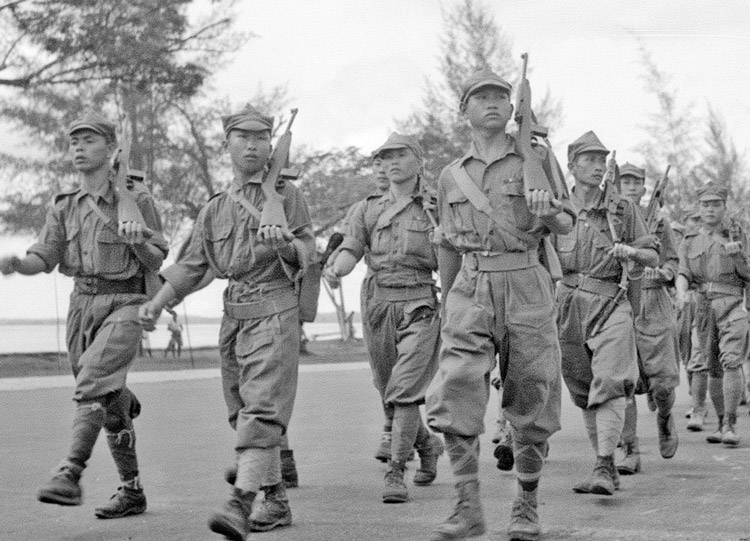
One of the important issues discussed at the November ISSCO conference in Malaysia was the history of the anti-imperialist struggle against British rule. What is now Malaysia was part of the British Empire from the late 1700s until independence was won in 1957. This April 14, 1952, Militant article, titled “Malaya’s Fight for Independence,” explains what was involved.
The British Tory government, reports the April 8 N.Y. Herald Tribune, has given “ full approval” to the savage reprisals inflicted upon an entire Malayan village for allegedly aiding guerrilla bands waging a struggle for national independence. “Last month,” says the Herald Tribune, “Secretary of State Dean Acheson gave strong American support to the British campaign.” What is the nature of this “campaign” to which Churchill-Acheson and Company give their whole-hearted support?
On March 28 the Associated Press reported that British High Commissioner General Sir Gerald Templer “has ordered the 5,000 villagers of Tanjong Malin under house arrest and cut their rice ration, accusing many of them of aiding Communist guerrillas in the area 45 miles north of this city.” This barbarous measure aroused voices of protest even in the British House of Lords. “Viscount Stansgate,” reports the April 8 Herald Tribune, protested that “no one could justify… preventing women and children from getting enough food when they had done nothing wrong.”
‘Collective Punishment’
The Earl of Listowel, a Labor peer, protested that “such ‘collective punishment’ was a new departure in British colonial policy.” But the Earl was either short of memory or ignorant of “British colonial policy.” Collective punishment has been practiced against the people of Malaya for years and condemning innocent women and children to hunger is only one of its milder forms.
The British imperialists have practiced a “scorched earth” policy in Malaya, burning villages, imposing collective fines, evacuating whole village populations, destroying homes and crops, because the people “failed to help British security forces in the campaign” against the guerrillas. And now the “civilizers” have come up with something new!
On April 5, a Reuters dispatch from Singapore disclosed that “chemical warfare from the air is to be launched” against what the imperialists call the “communist bandit food-growing areas in the depths of the Malayan jungle.” The New York Times, April 5, reports that the British owned Straits Times, which the N.Y. Times characterizes as one of the most reliable newspapers in the Far East, reports that British planes “flying low over jungle clearings, would spray large areas ‘with a withering chemical destroying food crops which support terrorist gangs.’” Such food-destroying chemicals have already been used, says the Times, and “chemicals had also been used to destroy trees along the sides of two dangerous roads in Malaya in order to deny terrorists natural cover.”
Why are the British imperialists and their American counterparts driven to practice such beastly atrocities upon innocent and helpless men, women and children in the Malayan jungle? Behind the spurious facade of a crusade against “communism” lurks the bloody hand of the imperialist exploiter of a rich colonial country and its people.
Colonial Prize
Malaya is a peninsula situated south of Burma and Siam (Thailand), north of Indonesia, and one of the rich countries of South Asia. The British cling to it not only because of the port and military base of Singapore but because Malaya also produces two thirds of the world’s natural rubber supply, one third of its tin, as well as rice, cocoa, sugar cane, coconuts, etc. It is a country of large plantations, beautiful cities and good roads. But it is also a jungle country dangerous to Europeans. There are no roads in the jungle, but there are guerrillas fighting for Asia’s freedom from colonial tyranny.
Malaya is a bi-national country inhabited mainly by 2,760,000 Malayans and 2,850,000 Chinese immigrants. The Chinese live in the cities and also in the countryside, but mainly form the towns’ population. They are denied citizenship under the “democratic” rule of the British.
The French bourgeois newspaper Le Monde has published an interesting and revealing series of articles by its special correspondent, Robert Guillain.
Guillain points out the predominant role of the Chinese in the Malayan war. The movement originated in the Malayan Chinese anti-Japanese resistance in World War II. The guerrilla army does not get any noticeable aid from the outside. The Malayan revolt is not organized in Moscow or in Peking; it is organized in Malaya. And it is actively or passively supported by almost the entire people — Malayans and Chinese — of the peninsula.
British Schemes
The British are trying to sponsor an anti-communist Malayan nationalist movement and anticommunist trade-unions. Guillain admits that this artificial “movement” is not very successful. The only kind of unity between Malayans and Chinese which is possible in Malaya is unity in common anti-imperialist actions, not unity in an alliance with the imperialists who, so far, have not even granted elementary political rights to the Chinese.
The guerrilla army itself is small. “Amidst a population of 6,500,000 inhabitants, the five thousand men whose organization calls itself Liberation Army of the Peoples of Malaya are like a handful of sand; but they are like grains of sand thrown into a motor: They seriously damage the entire machine,” says Guillain. The five thousand are supported by many other thousands. They are not isolated and are therefore able to wage a continuous campaign of sabotage against 25,000 British soldiers and 100,000 policemen, a campaign that started in June 1948.
The Liberation Army has been capable of plunging the British colonialists into an atmosphere of uncertainty. The British are unable to defeat it. At any time the guerrillas can retreat into the jungle or come out of the jungle. Pursuing them is not much use. Their weapons are light; they can easily carry them. And the jungle is immense. And there even exists a second jungle: The Chinese community in the cities. It is difficult to find a guerrilla fighter hidden by Chinese sympathizers. And there are practically no “Quislings” to betray him to the British. The Chinese communities are impenetrable.
The Liberation Army is not the group of “ bandits” the British talk about in their official communiques. It is, in fact, a uniformed, highly disciplined organization, divided into regiments (each of 500 or 600 men), companies and platoons. The Liberation Army has a unified command and a planned strategy. This “Red Army of the Jungle,” as Guillain calls it, also attaches great importance to the political education of every soldier and officer. Each unit has its political instructor. Each unit has its regular educational courses.
“Karl Marx in the deep jungle,” reads one of Guillain’s subheads. When they are not in action, the guerrillas have to study each day the questions of economy, politics and revolutionary strategy. Tropical diseases and heat cannot vanquish their determination. They edit their own newspapers under almost fantastic difficulties. They even publish books. Their theories may be influenced by Stalinism to a considerable extent — we do not know about this. But we do know that an army of partisans waging its own struggle under its own leadership and supported by a revolutionary movement of the people is bound to develop a policy of its own, to become increasingly independent from the Kremlin. This is proven by the examples of Yugoslavia and China.
The British at present attempt a hunger blockade against the partisans in the jungle after the failure of every other military measure. They are bound to fail again. Hunger will not break the spirit of Marx. And townspeople and farmers will both continue to help the Liberation Army. For they see the downfall of colonialism at the end of the road, even if the struggle is long and painful. The Malayan people know that this is but one of the fronts of an entire continent in revolt.