
WASHINGTON — After 275 days in prison, Kilmar Abrego García, a 30-year-old construction apprentice and member of SMART Local 100, was released from immigration detention Dec. 11.
U.S. District Judge Paula Xinis in Maryland ordered Kristi Noem, the Department of Homeland Security secretary, and other government officials to release him, finding immigration authorities had no lawful authority to detain or deport him. She ruled that a 2019 ruling used to deport him last March lacks a judge’s order to remove him. In other words, Abrego García should never have been stopped by Immigration and Customs Enforcement agents and arrested in the first place.
Abrego García was taken into ICE custody in Beltsville, Maryland, while driving in his car with his son. He was flown illegally to El Salvador where he was thrown in the notorious CECOT Max prison and systematically beaten and tortured.
His deportation was a gross violation of his constitutional right to due process, and another 2019 court order barring the government from sending him to El Salvador, where he was born. He and his family had been threatened by gangs there. The new ruling by Judge Xinis meant there was, in fact, no actual order to deport him at all.
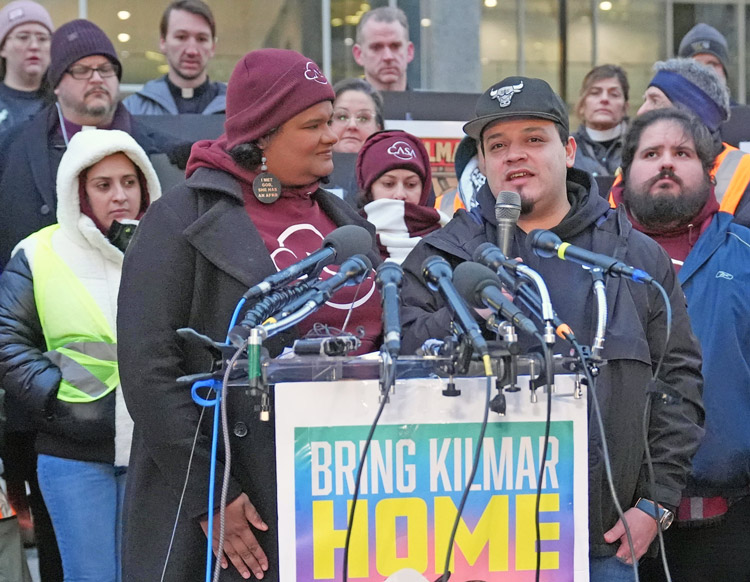
Once he was freed from the Moshannon Valley Processing Center in Pennsylvania, Abrego García drove over 200 miles home to Maryland, where he was reunited with his wife, Jennifer Vásquez Sura, his children, his brother César and mother Cecelia, and supporters from CASA, the immigrant rights group that defends him and organized to welcome him home.
The SMART union, which has been part of his defense from the beginning, shared the celebration. “Kilmar and his family have finally been given the chance to see each other again,” General President Michael Coleman posted prominently on the union’s website. Abrego García’s fight is a flashpoint in the broader battle for the rights of undocumented workers for the unity of the working class.
Government vindictiveness
Under the terms of his release, Abrego García was ordered to appear at a mandatory ICE check-in at the Baltimore field office Dec. 12, 14 hours after his release the night before. The Donald Trump administration lost no time in moving yet again to deport him. As Abrego García was driving home, Philip Taylor, acting regional deputy chief immigration judge in Baltimore, rushed out a new order around 7 p.m. to “correct” the 2019 order, claiming the fact it did not contain a deportation order was just a court clerk’s mistake.
Simon Sandoval-Moshenberg, Abrego García’s lawyer, got a restraining order from Xinis barring immigration authorities from detaining him again.
Abrego García addressed his supporters before entering the building for his ICE check-in. “I stand here before you, and the fight will continue. I will remain standing. I will not bow my head to anyone,” he said. “I will always stand against the injustices this government has committed.” He was interrupted with chants of “Sí, se puede” and “Todos somos Kilmar.”
He thanked his “luchadores,” Spanish for fighters — his wife, family, his union and CASA, and all of his supporters everywhere who have helped in his fight. He said the families of other immigrants like him that have been separated from one another should also “Keep fighting!”
His supporters surrounded him as he walked into the building, and then again as he walked out. Abrego García remains free. But new rounds in his protracted battle for asylum lie ahead.
On Dec. 17 the Metropolitan Washington Council AFL-CIO broadly sent out an email “Kilmar Abrego García released from ICE custody,” which included the remarks Abrego García made Dec. 12.
The far-reaching criminal vindictiveness of the Trump administration, including its insistence on deporting him to Africa, where he has no connections, has played out in court for months. The Department of Justice attempted to deport him to Uganda, Eswatini, Ghana and, most recently, Liberia. They’ve insisted refugee status or residency in Costa Rica was impossible, that the country’s government didn’t want him. But Costa Rican Minister of Security Mario Zamora told the court, “Costa Rica’s offer to receive Mr. Abrego García for humanitarian reasons remains in place.”
On Nov. 20 the government called its key witness, a top ICE official, John Cantu, to testify in response to an order from Xinis to produce someone who knew their case top to bottom. But he testified his sworn declaration against Abrego García was drafted by someone else, and admitted he didn’t understand parts of his own statement. He said he had no involvement with the Abrego García case until last month, and then only took part in a “five minute Teams call” with the Department of State.
When the government finally obeyed a U.S. Supreme Court order to return him to the U.S., the Justice Department filed charges of human trafficking against Abrego García in Tennessee. This case is a frame-up.
The judge there, Waverly Crenshaw, says the government’s case is a “poor attempt to tie Abrego to MS-13,” a Salvadoran gang. And he is considering throwing the case out as a “vindictive” prosecution. Abrego García has steadfastly maintained his innocence and refused to take a plea deal.
For now, it looks like Abrego García will spend the holidays at home with his family and friends.