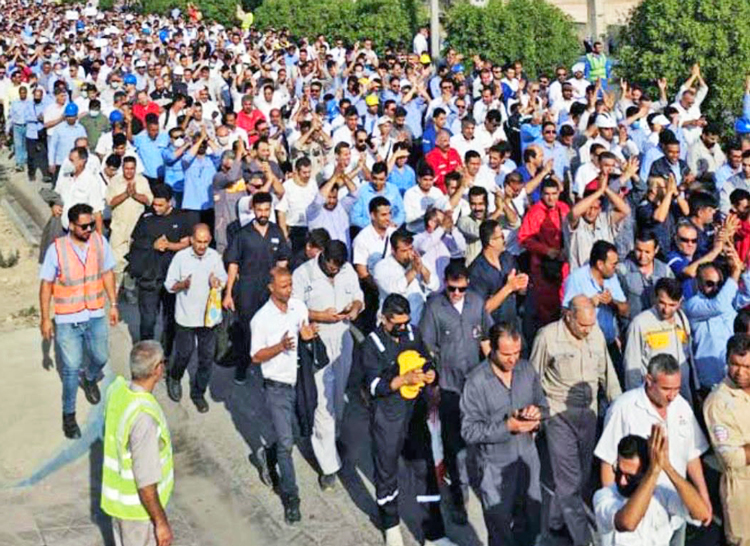
In one of the largest actions by oil and gas workers in Iran in decades, 5,000 contract workers from 12 South Pars refineries and many family members marched in Asaluyeh Dec. 9, demanding higher wages, more humane work schedules, job safety and better benefits. The action grew out of 18 consecutive weekly protests.
The next day hundreds of oil, gas and energy workers protested outside the Majlis, the national parliament in Tehran, to demand the abolishment of the hated contract labor system. The overwhelming majority of workers in Iran, including in the oil industry, work through contractors, employment agencies or under temporary contracts.
The protest in Asaluyeh was called by the Bushehr Gas Refinery Workers Union, which has close ties to a wing of the Iranian regime. The union publicized the march for over a week.
Asaluyeh is a port city and capital of Bushehr province in southern Iran and the center of the South Pars/North Dome Gas Field, the world’s largest, shared between Iran and Qatar.
In an attempt to keep workers from participating, police blocked off roads and set up barriers. The union responded by organizing workers into two disciplined groups that successfully marched toward the governor’s office.
Among the chants at the march were “18 million tomans [$144] in wages, 15 million in rent,” and “Stealing workers’ rights is a betrayal of the country.”
‘We’re not begging, we’re warning’
“We are not begging. We are warning you: Cut off the hands of the those leechlike contractors from our lives, our property and our tables,” an oil worker said in a speech to the action.
The contract companies “are owned by regime insiders and government profiteers who, acting as intermediaries between the oil industry and the workers, employ them under far more exploitative, near-slave-labor conditions with wages and benefits roughly half those of official and directly contracted workers,” the Free Union of Iranian Workers said, commenting on the Tehran protest. The same is true in other industries.
Some contractors in the oil and gas industry are owned by the Islamic Revolutionary Guard Corps, a central part of the regime’s apparatus to repress opposition to its rule.
Oil, gas and energy workers were joined in the Dec. 10 demonstration in front of the Majlis by workers from the agricultural bank and from the government welfare agency.
The welfare agency workers held simultaneous protests across the country. Their banners said, “We are welfare employees, but we ourselves lack welfare.”
The power and breadth of the oil workers’ protest, and their ability to attract other workers, was reflected in two members of parliament speaking to the protesters in the Tehran action. “You are right,” one MP told the crowd, “we are following up on converting your employment status — but it will take time.”
The Free Union of Iranian Workers reported that MP Hassan Nowruzi “even shamelessly uses the 12-day war [with Israel] as an excuse, saying, ‘We are all in the same boat’” and warning workers against holding protests.
“No sir! We workers and you plunderers are not in the same boat,” the union said. “You and your government have punctured the boat that carries our livelihood, and through these holes you are looting everything we have.”
The protests take place amid growing opposition among working people to the regime’s support to Hamas and war against Israel, to the plunging value of the national currency, rising prices of basic goods, a steep increase in executions of prisoners charged with drug offenses and other crimes, a wave of arrests of union and political activists, and widespread defiance of the regime’s dress code that requires women to wear the hijab to cover their hair.