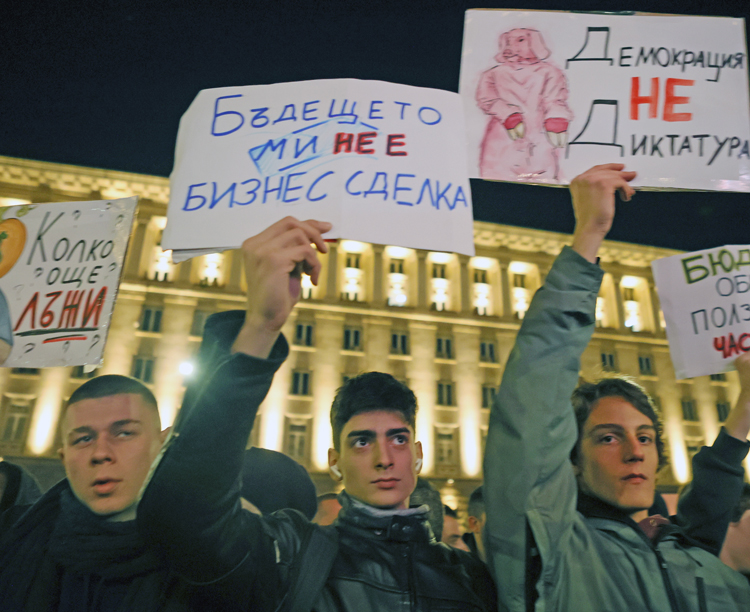
The challenges confronting Bulgaria’s capitalist rulers increased following a wave of protests against budget proposals. Next month Bulgaria joins the bloc of countries using the euro currency, as its rulers try to attract foreign investment, with competition for markets and resources deepening among Europe’s rival capitalist powers.
Beginning in late November protests grew, from tens of thousands to 100,000. Working people and others took to the streets of Sofia and other cities in Bulgaria to demand the conservative governing coalition headed by Prime Minister Rosen Zhelyazkov scrap a budget that increased taxes and social security contributions. He resigned and his government collapsed Dec. 11.
Defenders of the budget claimed the increases were needed to meet the eurozone’s membership requirement that the government’s budget deficit be no more than 3% of the country’s gross domestic product.
These protests reflect the response of working people worldwide to the deepening crisis of capitalism today.
Bulgaria’s rulers have faced political instability for years. They’ve had seven elections and a succession of short-lived governments since 2021. Zhelyazkov had survived six no-confidence votes since taking office in January.
The demonstrations were backed by liberal opposition capitalist parties, We Continue to Change and Democratic Bulgaria.
In July, We Continue to Change mounted protests against the arrest of Blagomir Kotsev, mayor of Varna, and Nikolay Barbutov, deputy mayor of Sofia. Both are members of this party, which claims the ruling coalition was planning to remove all opposition officeholders in the country’s major towns. Kotsev was freed Nov. 28, Barbutov remains under house arrest.
Workers and youth who are opposed to the country joining the eurozone as well as those in favor were both part of the actions that swept Zhelyazkov from office. “We want to be a European country, not one ruled by corruption and mafia,” student Ventsislava Vasileva told Agence France-Presse at one of the protests.
Bulgarian President Rumen Radev is consulting with different parties to try to form a new government.
Meanwhile, the pro-Moscow Vazrazhdane party has submitted a resolution proposing to postpone entry into the eurozone. Bulgaria’s parliament has repeatedly rejected proposals to hold a referendum on whether to join. Recent opinion polls show neither those for nor against command majority support. Thousands demonstrated against adopting the euro prior to the government voting to do so in September.
The European Commission — dominated by Berlin and Paris, the strongest imperialist powers in the bloc — says Bulgaria will be admitted into the eurozone regardless of the political situation in the country.
Bulgaria is the poorest country in the European Union, with a population that has declined from nearly 9 million in the 1980s to 6.8 million today, the result of continuing emigration. The average monthly wage is about $415.
Following the fall of Zhelyazkov’s government, the Confederation of Independent Trade Unions of Bulgaria held a new round of protests outside the parliament to oppose any step to freeze the wage raises for public sector workers and benefit increases that had been included in Zhelyazkov’s failed budget proposal.